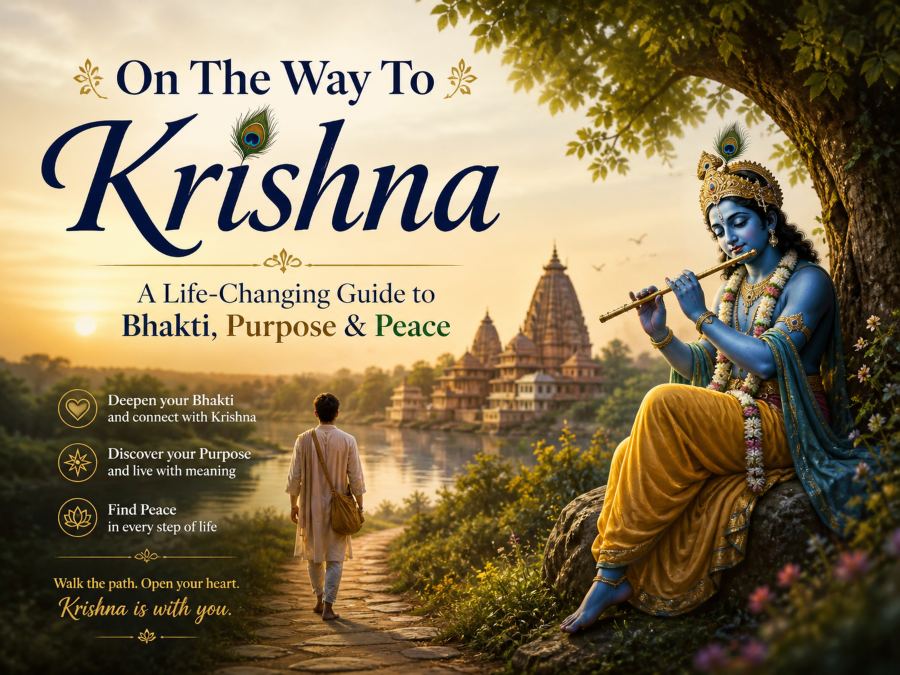
Rupa Goswami’s Forbidden Map to Prema: The Secrets of Bhakti Rasamrita Sindhu
Why would a sixteenth-century saint write an entire book cataloging exactly how devotion goes wrong? Most religious texts sell you the destination. Bhakti Rasamrita Sindhu does something rarer — it hands you the map, including every wrong turn, every dead end, and every trap that has swallowed sincere seekers for centuries. Rupa Goswami wasn’t interested in inspiring you with vague promises. He wanted you to actually arrive, which meant being honest about everything that stops people from getting there. That level of honesty is hard to find, and the complete text is available through the ISKCON Mayapur Store, translated and presented through the same lineage that has protected this knowledge since it was first written down in Vrindavana.
Call it “forbidden” not because anyone hid it, but because most spiritual literature avoids exactly the territory this book walks straight into: the specific, nameable ways devotion quietly fails while still looking successful from the outside.
The Map Nobody Wants to Read Carefully
Here’s an uncomfortable truth about spiritual practice in any tradition: most failure isn’t dramatic. Nobody usually abandons devotion in one visible moment of rebellion. Instead, practice slowly hollows out from the inside while all the external signs — attendance, ritual performance, vocabulary — stay perfectly intact.
Rupa Goswami built his text specifically to catch this kind of failure before it calcifies. That’s what makes Bhakti Rasamrita Sindhu genuinely unusual among devotional literature. It doesn’t just describe the peak experience of loving Krishna. It spends enormous energy describing the terrain between where most people start and where almost nobody actually arrives — and names, with uncomfortable precision, exactly what typically goes wrong along the way.
Secret One: Correct Behavior Can Still Be Empty
The first secret buried in this text unsettles people who assume spiritual progress is measured by external compliance. Rupa Goswami draws a sharp distinction between two categories that look nearly identical from the outside:
- Someone performing every devotional activity correctly, following every rule, chanting the prescribed number of rounds, attending every ceremony
- Someone whose heart is actually engaged in that same activity, present and attentive rather than mechanically going through motions
He insists these are not the same thing, and that only the second one counts as real progress toward prema. This is genuinely radical when you consider how most religious communities — across traditions — tend to measure devotion by visible compliance. Rupa Goswami is saying, in effect, that a person could check every external box for decades and still be nowhere near the actual goal, while someone with far less perfect external practice but genuine heart-engagement could be moving rapidly.
This isn’t an excuse to abandon discipline. The text is clear that structured practice remains necessary. But it strips away the comfortable illusion that correct behavior alone guarantees anything.
Secret Two: The Ten Offenses That Sabotage Chanting From Within
If there’s one section of this text that functions like a genuine warning label, it’s the catalog of offenses against the holy name. These aren’t abstract sins. They’re specific, recognizable patterns that quietly poison what should be the most powerful devotional practice available.
A few of the patterns Rupa Goswami identifies:
- Criticizing advanced devotees, even subtly, while continuing to chant — a contradiction that undermines the very practice it accompanies
- Treating the holy name as equivalent to pious ritual actions described elsewhere in scripture, rather than recognizing it as something categorically different and more potent
- Chanting while the mind wanders toward material concerns, going through the motion without attention actually present
- Committing sin deliberately on the assumption that chanting will erase it — treating the name as a license rather than a practice
What makes this list genuinely useful rather than just guilt-inducing is its specificity. Vague warnings about “impurity” don’t help anyone identify what’s actually happening in their own practice. This list does. Most sincere long-term practitioners, reading through it honestly, recognize at least one pattern they’ve fallen into without realizing it.
Secret Three: Emotion Can Be Faked, and the Text Knows It
Here’s something that separates Rupa Goswami’s approach from a lot of devotional literature: he doesn’t assume that displayed emotion equals real spiritual advancement. He was writing during a period when ecstatic displays — tears, trembling, visible rapture — were becoming culturally associated with advanced devotion. And he pushed back against the assumption that visible emotion always indicates genuine internal state.
The text describes categories of abhasa — the mere appearance or reflection of genuine spiritual emotion, without the substance behind it. This matters enormously in any devotional community, because performed emotion tends to be socially rewarded. People notice and praise visible displays of devotion. That social reward creates a quiet incentive to perform feeling rather than cultivate it.
Rupa Goswami’s secret here is essentially a warning against spiritual theater — the temptation, often unconscious, to display the signs of advancement rather than doing the slower, less visible work of actually reaching it.
Secret Four: Your Relationship With Krishna Was Never Meant to Be Chosen
Most people, when they first learn about the five rasas — the different relationships a devotee can have with Krishna — try to pick one. Which sounds most appealing? Friendship seems approachable. Parental affection feels warm. Romantic love sounds like the deepest option, so maybe that’s the “best” choice.
Rupa Goswami’s actual position undercuts this entire approach. He describes these relationships — shanta (reverential neutrality), dasya (servitude), sakhya (friendship), vatsalya (parental tenderness), and madhurya (romantic longing) — as natural inclinations that surface from within a devotee’s own heart as practice matures, not preferences selected through comparison shopping.
This is a genuinely counterintuitive secret: trying to analytically choose your rasa is itself a sign of working at the wrong level. The text suggests that forcing an emotional relationship you don’t naturally feel produces something artificial, no matter how sincerely you try. The real relationship reveals itself. It isn’t decided.
Secret Five: Prema Isn’t the Reward for Effort — It’s Something Else Entirely
Perhaps the most counterintuitive secret in the entire text concerns how prema, pure love of Krishna, actually arrives. Most spiritual systems present advancement as a direct function of effort: work harder, advance faster, reach the goal through sufficient discipline.
Rupa Goswami complicates this considerably. He describes prema as ultimately a gift — something that grace supplies once the ground has been properly prepared through practice, but that effort alone cannot manufacture. This creates an interesting paradox that the text doesn’t try to resolve neatly: you must act as though everything depends on your effort, while understanding that the actual breakthrough depends on something beyond effort entirely.
This isn’t a loophole for laziness. Rupa Goswami is explicit that the preparatory work — practice, purification, association with genuine devotees — remains essential. But the secret here undercuts any purely transactional view of spiritual life, where enough units of practice guarantee a proportional spiritual reward. The relationship between effort and result, according to this text, isn’t linear or fully predictable.
Why Association Matters More Than the Text Admits Upfront
Buried throughout the book, rather than isolated in one section, is a claim that becomes more obvious the more carefully you read: almost nothing described in this text works reliably in isolation. Sadhu-sanga — association with devotees further along the path — shows up repeatedly as the accelerant that makes everything else function.
This raises an uncomfortable question for anyone approaching Krishna consciousness primarily through solitary reading: can you actually reach the destinations this text describes without that association? Rupa Goswami’s implicit answer seems to be that you can move somewhat, but the pace and depth available through community and guidance simply isn’t accessible through study alone.
This is part of why ISKCON, from its founding, has been structured around temple community rather than purely individual practice. The text itself seems to anticipate and require that structure.
The Map That Built a Global Movement
It’s worth remembering that this “forbidden map” didn’t stay confined to a small circle of Sanskrit scholars. Srila Prabhupada carried this exact framework — the offense categories, the rasa classifications, the honest treatment of spiritual failure modes — to audiences that had no prior exposure to any of this vocabulary, and it became the operational theology of ISKCON temples worldwide, including at the movement’s spiritual heart in Mayapur.
The transmission has stayed remarkably intact across five centuries: Chaitanya Mahaprabhu inspired the systematic study; Rupa Goswami wrote it into precise textual form during his years in Vrindavana; Bhaktivinoda Thakura and Bhaktisiddhanta Saraswati preserved and clarified it through the following centuries; and the Bhaktivedanta Book Trust, under Srila Prabhupada’s direction, made the complete map accessible globally.
How to Actually Read a Map Like This
A map is useless unless you’re willing to look honestly at where you currently stand on it. A few practical notes for anyone approaching this text seriously:
- Read the offense section slowly and specifically, not as background information but as a personal diagnostic. Most people find something they recognize.
- Notice the difference between performing devotion and feeling it, honestly, in your own practice — not to generate guilt, but to redirect attention toward what actually matters.
- Resist the urge to intellectually select your rasa. Let it surface rather than choosing it the way you’d choose a product.
- Take the grace element seriously. Effort matters enormously, but expecting a purely mechanical, guaranteed outcome from a fixed amount of practice sets up unnecessary frustration.
- Don’t attempt this in isolation. The map assumes community. Find it.
What This Forbidden Map Actually Protects You From
Strip away the mystique of the word “forbidden,” and what Rupa Goswami actually built was something closer to protective knowledge — the accumulated observations of someone who watched sincere seekers fail in predictable, recognizable patterns, and decided to write those patterns down so future generations wouldn’t have to discover them the hard way.
That’s a rare kind of honesty in spiritual literature, and it’s exactly why serious students keep returning to the complete original text rather than relying on fragments and paraphrases. The map only works if you can see the whole terrain, warnings included — which is precisely what the full translation preserves, offense by offense, secret by secret, all the way to the destination Rupa Goswami spent his life trying to describe.
The map has been available for five hundred years. Whether you actually follow it is still, as it always was, entirely up to you.