

Imagine skipping a meal and, in doing so, stepping closer to God. That sounds almost too simple. Yet for millions of Vaishnavas across the world, this is not a metaphor — it is a lived reality practiced twice every month, on a day called Ekadashi.
But Ekadashi is not just a diet schedule dressed in spiritual clothing. It is one of the most ancient, most documented, and most misunderstood observances in the Vedic tradition. If you have ever wondered why devotees refuse rice on certain days, why the lunar calendar governs fasting in Hinduism, or what exactly happens when you observe Ekadashi sincerely—this guide covers everything. No surface-level overview. Just the real thing.
What Is Ekadashi, Exactly?
The word itself is Sanskrit. Eka means one, dashi means ten — together, Ekadashi means the eleventh. Specifically, it refers to the eleventh day of each lunar fortnight (paksha) in the Hindu calendar. Since there are two fortnights in every lunar month — the waxing phase (Shukla Paksha) and the waning phase (Krishna Paksha) — Ekadashi occurs twice a month, giving us roughly 24 Ekadashis every year.
Each of these 24 Ekadashis has its own name, its own story, its own deity of focus, and its own set of specific benefits described in the Puranas. They are not interchangeable. Observing Nirjala Ekadashi is not the same as observing Putrada Ekadashi — even though both fall on the eleventh lunar day.
This is where Ekadashi gets interesting. It is a system, not a single event.
The Spiritual Logic Behind Ekadashi Fasting
Before diving into the list of all 24 Ekadashis, it is worth understanding why this particular day was chosen for fasting. The answer is not arbitrary.
The Moon, the Mind, and Your Appetite
In Vedic cosmology, the moon directly influences the human mind. The Sanskrit word for mind—manas—shares its root with the moon (chandra). Tidal patterns, menstrual cycles, emotional fluctuations — ancient Indian science observed that the moon’s gravitational pull affected bodily fluids and mental states.
On the eleventh lunar day, a specific energetic configuration arises that makes the mind more easily drawn toward spiritual activity and less demanding about physical comfort. Fasting on this day, therefore, is not an act of self-punishment. It is working with the cosmic rhythm rather than against it.
Srila Prabhupada, the founder-acharya of ISKCON, explained this directly: the purpose of Ekadashi is to minimize bodily demands so that more energy can be directed toward Krishna consciousness. Less digestion means more meditation. It is surprisingly practical.
The Story That Started It All
The Padma Purana contains the origin story of Ekadashi. At the beginning of creation, Lord Vishnu created a female form — a personified energy — from His own body. This form became the goddess Ekadashi. When a demon named Mura was attacking the devas (celestial beings), all efforts failed. Lord Vishnu Himself entered into yogic sleep to gather energy for the battle.
Mura attempted to kill Vishnu while He slept. At that critical moment, the goddess Ekadashi emerged from Vishnu’s body and destroyed the demon. Pleased, Lord Vishnu granted her a boon. She requested that those who observe a fast on this day should be freed from all sins and eventually attain liberation.
Vishnu agreed. And that, according to the Puranas, is why Ekadashi fasting holds such extraordinary weight.
The Rules: What You Can and Cannot Do on Ekadashi
This is the section that confuses most beginners. The rules vary slightly by tradition, but in the Vaishnava lineage — which follows the Hari Bhakti Vilasa and the directives of the Goswamis of Vrindavana — the guidelines are relatively clear.
What to Avoid on Ekadashi
Grains and legumes are the primary restriction. This includes rice, wheat, barley, lentils, dal, chickpeas, and anything made from them — bread, pasta, chapati, and so on. The reasoning: grains are considered heavy, tamasic (inertia-producing) foods that tax digestion and dull the mind.
Additionally:
- Meat, fish, and eggs — always avoided by serious Vaishnavas, more so on Ekadashi
- Intoxicants — tea and coffee are sometimes included in stricter observances
- Gambling and excessive sleep — Ekadashi is a day for heightened consciousness, not dullness
- Oil and spices — some traditions fast on water alone; others permit fruits, roots, milk, and certain vegetables
Sex and anger should also be consciously restrained. The idea is total sense control, not just dietary restriction.
What Is Permitted
Fruits, roots, nuts, dairy products, certain vegetables (avoiding leafy greens in some traditions), and water. Sendha namak (rock salt) is used instead of regular salt. Buckwheat (kuttu), water chestnut flour (singhare ka atta), and sago (sabudana) are common fasting foods in Indian households.
The strictest form of Ekadashi fasting is Nirjala Ekadashi — no food, no water, not even a drop. More on that shortly.
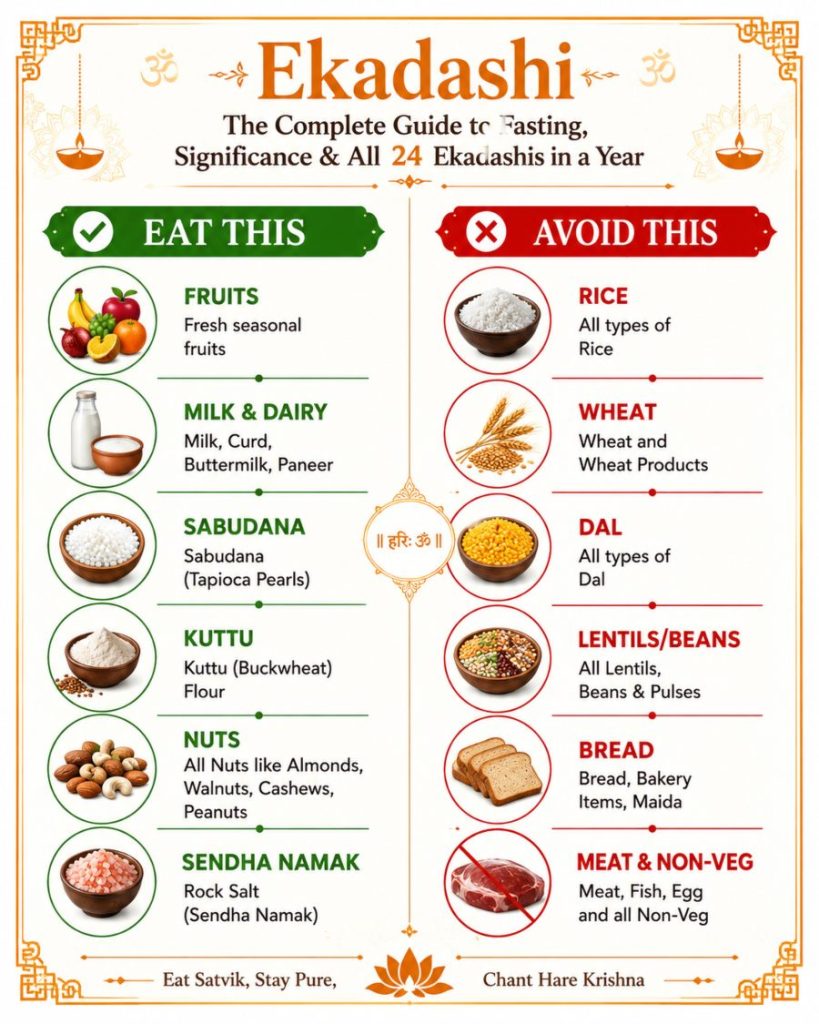
All 24 Ekadashis of the Year — Names, Meanings & Significance
Here is the complete list of all 24 Ekadashis, organized through the Hindu lunar calendar year. Note that in leap years, an extra Ekadashi (Adhika Ekadashi) may be added, making it 26. The dates shift annually, so always check a Vaishnava calendar (Panchanga) for the exact date each year.
Magha Month (January–February)
1. Shattila Ekadashi (Krishna Paksha — waning fortnight) Named after shat (six) uses of sesame seeds (tila). Observing this Ekadashi with sesame seed-related rituals is said to destroy sins accumulated over many lifetimes. The story is found in the Bhavishya Purana.
2. Jaya Ekadashi (Shukla Paksha — waxing fortnight) This one liberates souls from ghostly existence. The Padma Purana narrates the story of two celestial beings—Push Pavanta and Chitrasena—who were cursed to become ghosts and were ultimately liberated through the merit of Jaya Ekadashi.
Read Also:- Mayapur
Phalguna Month (February–March)
3. Vijaya Ekadashi (Krishna Paksha) Victory is the theme here. According to the Skanda Purana, Lord Rama observed this Ekadashi before crossing the ocean to Lanka. The fast bestows victory over enemies and obstacles.
4. Amalaki Ekadashi (Shukla Paksha) Dedicated to the amalaki tree (Indian gooseberry / amla), considered an earthly manifestation of Lord Vishnu. Worshipping under an amalaki tree on this day is believed to be enormously meritorious. Found in the Brahmanda Purana.
Chaitra Month (March–April)
5. Papamochani Ekadashi (Krishna Paksha) Papamochani literally means “one that removes sins.” The story involves the sage Medhavi and a celestial dancer who tried to tempt him away from his austerities. The fast on this day destroys even the most serious past transgressions.
6. Kamada (Shukla Paksha) Kamada means “one who fulfills desires.” This is one of the most celebrated Ekadashis, observed during the auspicious Chaitra month. It is said to fulfill the devotee’s spiritual desires and free relatives from ghostly bodies.
Vaishakha Month (April–May)
7. Varuthini Ekadashi (Krishna Paksha) This Ekadashi is compared in merit to performing great charity and austerity. Even donating land, said to be the greatest of charities, does not equal the merit of Varuthini Ekadashi, according to the Bhavishya Purana.
8. Mohini Ekadashi (Shukla Paksha) Mohini is the enchanting feminine form Lord Vishnu assumed to distribute nectar (amrita) only to the gods after the churning of the ocean. Fasting on this day is said to cut through the illusion (moha) that binds the soul to the material world.
Jyeshtha Month (May–June)
9. Apara Ekadashi (Krishna Paksha) Apara means “immeasurable” or “unlimited.” The merits of this fast are described as equivalent to bathing in all sacred rivers, visiting all pilgrimage sites, and performing all yajnas (sacrifices). It destroys the sin of killing a Brahmin, according to tradition.
10. Nirjala Ekadashi (Shukla Paksha) This is the king of all Ekadashis. No food. No water. Not even mouth-rinsing. It is observed only once a year, during the hot summer month of Jyeshtha, and its merit is said to equal all 24 Ekadashis combined. The story involves Bhima — the second Pandava and a man of enormous appetite — who found it impossible to fast on every Ekadashi. The sage Vyasa told him: fast just this one day, without water, and you accumulate the merit of all Ekadashis in a single day. It remains one of the most testing acts of devotion a practitioner can undertake.
Ashadha Month (June–July)
11. Yogini Ekadashi (Krishna Paksha) This Ekadashi liberates those who suffer from leprosy and other serious physical ailments, according to the Brahma Vaivarta Purana. The story of a gardener named Hema who inadvertently offended Lord Shiva and later found redemption through this fast is particularly moving.
12. Devshayani Ekadashi (Shukla Paksha) Also called Ashadi Ekadashi or Padma Ekadashi, this is the day Lord Vishnu begins His four-month cosmic sleep (Chaturmasya). It marks the beginning of the Chaturmasya period — four months during which Vaishnavas take additional vows, sages do not travel, and spiritual practices are intensified. Hugely significant in Maharashtra (the Wari pilgrimage) and across India.
Ekadashis of Shravana Month (July–August)
13. Kamika Ekadashi (Krishna Paksha) Observing this Ekadashi, says the Brahma Vaivarta Purana, is equal to bathing in the Ganges, Yamuna, Godavari, Narmada, Kaveri, and Saraswati rivers simultaneously. Tulsi leaves (sacred basil) offered to Vishnu on this day are especially potent.
14. Shravana Putrada Ekadashi (Shukla Paksha) Putrada means “giver of a son.” This Ekadashi is specifically observed by those desiring children, particularly a son, as per traditional Vedic aspiration. The story involves King Suketuman and his queen Shaibya, who were childless and ultimately blessed after this fast.
Ekadashis of Bhadrapada Month (August–September)
15. Aja Ekadashi (Krishna Paksha) Aja means “unborn” — a name for Lord Vishnu. The merit of this Ekadashi is compared to donating one thousand cows along with gold. The story of King Harishchandra, who suffered tremendous misfortune before being liberated through this fast, is one of the most dramatic narratives in Ekadashi literature.
16. Parivartini Ekadashi (Shukla Paksha) Also called Parsva Ekadashi or Vamana Ekadashi, this day marks the moment when Lord Vishnu turns over in His cosmic sleep — mid-way through Chaturmasya. It coincides with the appearance of Lord Vamana (the dwarf incarnation) and is considered extraordinarily auspicious.
Ashwin Month (September–October)
17. Indira Ekadashi (Krishna Paksha) This Ekadashi is unique because it is observed specifically to liberate ancestors (pitrs) who may be suffering in hellish conditions. The merit transfers to deceased family members. Observed during Pitru Paksha, the fortnight dedicated to ancestors, it carries an especially compassionate purpose.
18. Papankusha Ekadashi (Shukla Paksha) Papankusha means “one who controls sin like an elephant goad controls an elephant.” Said to purify sins of many lifetimes and even allow one to reach Vaikuntha (the spiritual realm) upon death.
Kartika Month (October–November)
19. Rama Ekadashi (Krishna Paksha) Observed just before Diwali season, this Ekadashi is dedicated to Goddess Lakshmi (Rama is one of Her names). Devotees pray for prosperity, liberation from sins, and protection from misfortune.
20. Devotthaana Ekadashi (Shukla Paksha) Also called Prabodhini Ekadashi or Tulsi Vivah Ekadashi — this is the day Lord Vishnu wakes from His four-month cosmic sleep. The entire Chaturmasya period ends here. Marriages resume (traditionally prohibited during Chaturmasya), and the marriage of Tulsi plant to Lord Vishnu (Shaligrama) is celebrated across India. This is one of the most festive Ekadashis of the year.
Margashirsha Month (November–December)
21. Utpanna Ekadashi (Krishna Paksha) This is the Ekadashi when the goddess Ekadashi herself was born from Lord Vishnu’s body to slay the demon Mura. It is considered the “origin” Ekadashi — the one whose story explains why all Ekadashis are sacred. Very significant in Vaishnava tradition.
22. Mokshada Ekadashi (Shukla Paksha) Mokshada means “giver of liberation.” This Ekadashi falls during the Gita Jayanti period — the anniversary of Lord Krishna speaking the Bhagavad Gita to Arjuna on the battlefield of Kurukshetra. Observing this Ekadashi is said to give liberation (moksha) not only to the devotee but also to deceased family members who are suffering.
Pausha Month (December–January)
23. Saphala Ekadashi (Krishna Paksha) Saphala means “fruitful” or “successful.” The story involves King Lumpaka, a sinner who inadvertently fasted on this Ekadashi after spending the night beneath a fig tree in the forest, and subsequently received liberation. Even accidental observance brings results — which speaks to the inherent potency of the day.
24. Pausha Putrada Ekadashi (Shukla Paksha) Like its counterpart in Shravana, this Ekadashi is also dedicated to those desiring children. It is particularly auspicious because it falls near Makar Sankranti. Bathing in a sacred river on this day before breaking the fast is especially recommended.
Why Does Ekadashi Forbid Rice Specifically?
This is one of the most commonly asked questions. The short answer: the Puranas describe subtle energies (sinful reactions) entering rice grains on Ekadashi.
The longer answer is more scientifically interesting. Rice is the heaviest, most difficult-to-digest grain — it produces the most ama (undigested toxins) according to Ayurveda. It also ferments quickly, creating conditions in the gut that dull the senses. Avoiding rice — and all grains — keeps digestion light and the mind alert.
The Vaishnava tradition adds another dimension: rice, wheat, and legumes are considered anna (grains), the very substance of bodily life. By abstaining from anna, you are symbolically declaring: today, I live by the grace of God, not by food.
How to Observe Ekadashi — A Practical Day-by-Day Guide
The Night Before (Dashami — Tenth Day)
- Eat a light, sattvic (pure) dinner before sunset
- Avoid eating after sunset if possible
- Get adequate sleep — you will want to be alert
On Ekadashi Itself
- Wake up during Brahma Muhurta (approximately 90 minutes before sunrise) — this is the most spiritually potent time of day
- Bathe and offer prayers to Lord Vishnu
- Chant the Hare Krishna mahamantra or Vishnu sahasranama
- Read or listen to the story specific to that Ekadashi
- Fast throughout the day — fruits, milk, nuts, and water are permitted (unless doing Nirjala)
- Visit the temple if possible; offer Tulsi to Lord Vishnu
- Engage in kirtan, reading scripture, and satsang (spiritual company)
- Avoid sleeping during the day on Ekadashi — it is considered inauspicious
- Stay awake at night if possible, chanting and praying
Breaking the Fast (Dwadashi — Twelfth Day)
- Break the fast only after sunrise on Dwadashi
- The parana (breaking of the fast) time is specific — check the Panchanga for the exact window
- Do not break the fast during Hari Vasara (the first quarter of Dwadashi)
- Begin with a small amount of water, then fruits, then a proper meal
Ekadashi in ISKCON: A Living Tradition
In ISKCON temples worldwide — including Sri Mayapur Dham, the global headquarters — Ekadashi is observed with exceptional seriousness. The full twenty-four Ekadashis are followed. The kitchen prepares only approved fasting foods. The programs run longer. Japa (mantra meditation) quotas are increased.
Srila Prabhupada himself observed Ekadashi strictly throughout his life and instructed his disciples to do the same. His books — including the Nectar of Devotion — emphasize Ekadashi as a direct way to please Lord Krishna. Not because Krishna demands austerity, but because austerity sharpens the devotee’s focus.
There is something quietly radical about this practice in the modern world. When everyone around you is eating and you are fasting — not out of diet culture or health anxiety, but out of love for God — it creates a distinct inner shift. That shift is what Ekadashi is designed to produce.
Common Mistakes to Avoid
Eating grains accidentally. Always check labels. Many packaged foods contain wheat starch or rice flour. On Ekadashi, read before you eat.
Breaking the fast at the wrong time. The Dwadashi parana window matters. Breaking the fast too early (during Hari Vasara) is considered a violation. Check your local Vaishnava calendar.
Sleeping during the day. It negates much of the merit. Stay active. Read. Chant. Engage.
Forgetting it is a day for devotion, not just food restriction. Skipping rice and spending the day watching television is not observing Ekadashi. The fasting is meant to redirect energy toward Krishna consciousness, not just create a calorie deficit.
Offering grains to the deity on Ekadashi. In Vaishnava temples, grain-based foods are not offered to the Lord on Ekadashi. Only fasting preparations are offered.
The Science Behind It All
Modern research has increasingly validated the benefits of periodic fasting — improved insulin sensitivity, cellular autophagy (the body’s self-cleaning process), reduced inflammation, and enhanced cognitive clarity. Intermittent fasting has become a global health trend. The Vedic tradition was prescribing it twice a month, four thousand years ago, with an added layer of spiritual intentionality.
The difference, of course, is motivation. Fasting to lose weight and fasting to remember God produce different internal states. Ekadashi practitioners often describe a heightened sense of clarity and peace that does not accompany ordinary dietary fasting. The mind-body-spirit alignment that Ekadashi cultivates may explain why this practice has survived, unbroken, across millennia.
Final Thoughts: Why Ekadashi Still Matters
There are days in the calendar that mark historical events. And then there are days that create direct access to something beyond history.
Ekadashi is the latter. It does not commemorate something that happened once. It opens a window that appears twice every month, reliably, like clockwork, inviting you to step through it.
Whether you are a lifelong devotee or someone who just heard about this practice for the first time — the offer is the same. Fast. Chant. Meditate. Remove the noise of appetite for one day, and see what fills the space.
For those walking the Vaishnava path, the answer is always the same: what fills the space is Krishna.
And that, in the end, is the whole point of Ekadashi.
Frequently Asked Questions About Ekadashi
Q1. How many Ekadashis are there in a year?
There are 24 Ekadashis in a regular lunar year — two per month, one in each fortnight (Shukla Paksha and Krishna Paksha). In a leap year (Adhika Maas), two extra Ekadashis are added, making it 26 total.
Q2. Can I drink water on Ekadashi?
Yes, in most observances water is permitted. The only exception is Nirjala Ekadashi — observed once a year in the Jyeshtha month — where even water is avoided from sunrise to the next morning’s parana time.
Q3. Why is rice not eaten on Ekadashi?
According to the Padma Purana, sinful reactions (papa) enter rice grains on Ekadashi. From an Ayurvedic angle, rice is the heaviest grain to digest and dulls the senses. Avoiding it keeps the mind light and alert for spiritual practice.
Q4. What can I eat on Ekadashi fasting?
You can eat fruits, nuts, milk, yogurt, potatoes, sweet potatoes, sabudana (sago), kuttu (buckwheat), singhare ka atta (water chestnut flour), and sendha namak (rock salt). All grains, lentils, and regular salt are avoided.
Q5. What time should I break my Ekadashi fast?
The fast is broken on Dwadashi (the twelfth day) after sunrise, within a specific time window called parana. Always check your local Vaishnava Panchanga for the exact parana timing — breaking the fast during Hari Vasara (the first quarter of Dwadashi) is not recommended.
Q6. Can women observe Ekadashi during menstruation?
Opinions vary by tradition. In many Vaishnava lineages, the internal spiritual observance — chanting, prayer, avoiding grains — continues even during menstruation, though temple visits and deity worship may be paused. Personal guidance from one’s spiritual teacher is advisable.
Q7. Is Ekadashi fasting the same in all Hindu traditions?
No. While the basic principle (fasting on the 11th lunar day) is shared, the specific rules vary. Vaishnavas follow the strictest and most detailed guidelines, as outlined in the Hari Bhakti Vilasa. Shaivites and other sampradayas may observe it differently.
Q8. What is the most important Ekadashi of the year?
Nirjala Ekadashi is considered the most powerful — its merit equals all 24 Ekadashis combined. Devotthaana Ekadashi (when Lord Vishnu wakes from cosmic sleep) and Mokshada Ekadashi (Gita Jayanti) are also among the most celebrated.
Q9. Can children and elderly people observe Ekadashi?
Children below a certain age (generally under 8), pregnant women, elderly, and seriously ill individuals are traditionally exempt from strict fasting. They may observe a lighter version — avoiding grains while eating fruits and milk normally.
Q10. Does accidentally eating grains on Ekadashi break the fast?
According to Vaishnava scripture, accidental consumption (ajnana) carries less karmic weight than deliberate violation. However, it is advisable to be careful — especially with packaged foods that may contain hidden grain-based ingredients like wheat starch or rice flour.


Thank you for sharing full ekadashi details