
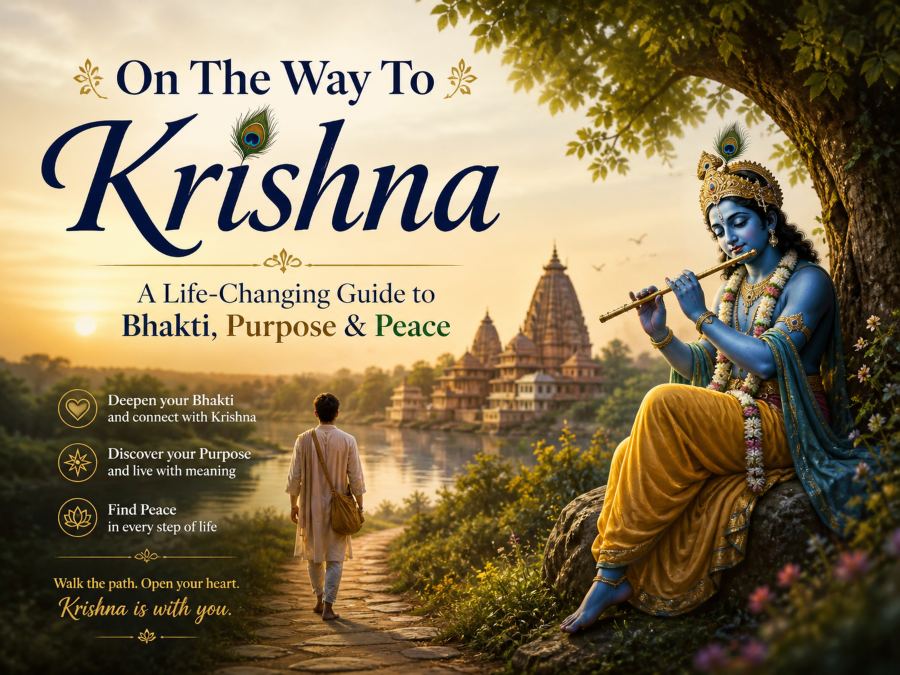
On The Way To Krishna: A Life-Changing Guide to Bhakti, Purpose & Peace
by Srila Prabhupada | A Timeless Spiritual Classic Reviewed in Depth
There are books you read once and forget. Then there are books that quietly rearrange something inside you — something deep, something you didn’t even know was crooked until it suddenly feels straight. On The Way To Krishna Book belongs firmly in the second category. Published by the founder-acharya of the International Society for Krishna Consciousness (ISKCON), His Divine Grace A.C. Bhaktivedanta Swami Prabhupada, this compact yet profound volume carries within its pages a complete philosophy of living — one that is as urgent and applicable today as it was when first compiled from lectures delivered decades ago.
This article explores the book’s core teachings, its structural brilliance, and why it continues to change lives across continents and cultures.
Who Wrote It and Why It Matters
Before diving into the content, it is worth pausing to understand the source. Srila Prabhupada was no armchair philosopher. He arrived in New York City in 1965 at the age of 69 with less than forty dollars in his pocket and a trunk full of Sanskrit scriptures. Within a decade, he had circled the globe fourteen times, authored over seventy books translated into dozens of languages, and established more than a hundred temples worldwide. He did not merely write about spiritual transformation — he embodied it.
On The Way To Krishna emerged from talks Prabhupada gave to his early Western disciples, young men and women who were genuinely asking questions that most religious traditions of that era struggled to answer directly: Why do I suffer? What is the purpose of my life? Is there something beyond material success? Is happiness even real, or is it just a temporary chemical event in the brain?
Prabhupada answered these questions not with vague spiritual platitudes but with the precise, logical framework of Vedic wisdom — the same tradition that gave the world yoga, Ayurveda, and the Bhagavad-gita.
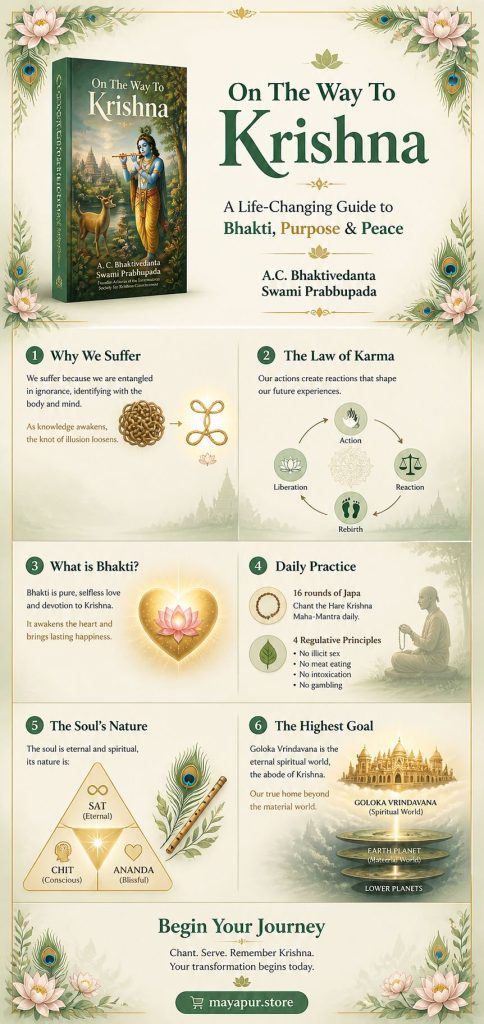
The Central Question: Why Do We Suffer?
The book opens with a question that every human being has asked at some point: Why is there suffering?
Prabhupada’s answer is both philosophically rigorous and practically liberating. He explains that suffering originates from ignorance — not ordinary ignorance about facts or data, but a fundamental misidentification. We mistake the body and mind for the self. We believe we are the temporary vehicle rather than the eternal passenger inside it.
This is not merely a metaphor. According to the Vedic tradition Prabhupada presents, each of us is an individual unit of consciousness — a jiva atma — who is qualitatively identical to the Supreme Consciousness (Krishna or God) but quantitatively infinitesimally small by comparison. Just as a spark shares the nature of fire but cannot claim to be the entire fire, we share qualities of the divine — consciousness, will, love, creativity — but we are not the source of these qualities.
When we forget this relationship, Prabhupada teaches, we try to become the center of our own universe. We seek pleasure, avoid pain, accumulate possessions, build identities, form attachments — and then we suffer when all of these inevitably shift, decay, or disappear. The suffering is not arbitrary. It is a signal pointing us back toward our original nature.
This is the foundation upon which the entire book rests, and it is presented not with dogmatic insistence but with the clarity of someone who has genuinely tested the philosophy in the laboratory of his own life.
The Law of Karma: Deeper Than Most People Think
One of the most illuminating chapters in the book addresses karma — a word that has become so casually used in modern culture that its actual meaning has been largely diluted. People say “that’s karma” when something goes wrong for someone who deserved it, treating it like a cosmic scoreboard.
Prabhupada restores the concept to its full depth. Karma is not simply a system of cosmic punishment and reward. It is the law of action and reaction — not just in this life, but across multiple lifetimes. Every action performed under the influence of material desire creates a reaction that must be experienced. These reactions bind the soul to the cycle of birth and death (samsara), not just in human bodies but across all forms of life.
What makes this teaching genuinely radical — and genuinely hopeful — is what follows: karma can be transcended. Not by doing better karma (performing good deeds motivated by personal desire for reward), but by acting in a completely different mode altogether — nishkama karma, or desireless action. The Bhagavad-gita calls this performing one’s duties without attachment to results. Prabhupada makes this accessible by explaining that the easiest, most complete form of desireless action is to act in devotion to Krishna — to offer everything you do, eat, think, and give as an act of worship.
When action is performed as an offering to the Supreme, it does not generate new karmic reactions. This is not a loophole. It is a fundamentally different mode of existing in the world — one rooted in love rather than self-interest.
The Transcendental Taste: What Is Bhakti?
Perhaps the most practically transformative section of On The Way To Krishna deals with bhakti — devotional service. This is the heart of the book, the jewel around which everything else is arranged.
Bhakti is often misunderstood as mere ritual worship — lighting incense, chanting mantras, bowing before deities. While these practices are part of it, Prabhupada is careful to explain that bhakti is fundamentally a quality of consciousness, not a set of external actions. A person can perform a thousand rituals mechanically and remain entirely untouched by bhakti. Conversely, someone who simply chants the name of Krishna with genuine feeling — even once — has touched something real.
The defining characteristic of bhakti is what Prabhupada calls transcendental taste — a quality of joy that is qualitatively different from all material pleasure. He makes an important distinction here that deserves careful attention. Material pleasures are real. Nobody is denying that good food, beautiful music, romantic love, or the thrill of achievement feel genuinely good. But these pleasures share a common limitation: they are temporary, they require specific external conditions, they carry within them the seed of their own ending, and they leave a residue of wanting more.
The taste of bhakti, Prabhupada explains, is different in kind, not merely in degree. It does not depend on external conditions. It does not diminish with repetition. In fact, it deepens — the more one engages in devotional service, the more fulfilling it becomes. This is the inverse of material pleasure, which tends to yield diminishing returns.
He supports this not merely with scripture but with the testimony of great saints across traditions — mystics who reported an inner joy that persisted through poverty, illness, persecution, and loss. The contemplative traditions of every major religion have preserved similar accounts. Prabhupada invites the reader to test this claim personally rather than simply accept it on faith.
The Role of the Spiritual Master
A chapter that often surprises Western readers is Prabhupada’s discussion of the guru — the spiritual master. In a culture deeply suspicious of authority, particularly religious authority, this topic requires careful navigation. Prabhupada navigates it with precision.
He is not advocating blind obedience. He explicitly states that a genuine spiritual master is not to be accepted on the basis of charisma, popularity, or mystical claims. A genuine guru can be identified by specific qualifications: he or she must be coming in an unbroken chain of disciplic succession (parampara) from Krishna himself, must be living according to the principles they teach, and must be capable of delivering the student from the cycle of birth and death — not merely offering temporary comfort or emotional consolation.
The relationship between student and teacher in bhakti is not one of dependence but of transmission. Just as a candle lights another candle without losing its own flame, a genuine spiritual master transmits the fire of Krishna consciousness to the sincere student without diminishing his own. The student receives not just knowledge but a living connection to the entire lineage of teachers stretching back through time.
This is a beautiful teaching, and Prabhupada presents it with both warmth and intellectual honesty. He acknowledges that there are false gurus in the world. He provides the tools to discern the difference. And he points to the written teachings of the great acharyas — which are available to anyone — as a safeguard against exploitation.
Read Also:- Mayapur dham
Practical Spirituality: Integrating Bhakti Into Daily Life
One of the greatest strengths of On The Way To Krishna is its refusal to remain abstract. Throughout the book, Prabhupada returns again and again to practical application. How does one actually begin this journey? What does bhakti look like in a daily schedule?
He recommends a deceptively simple starting point: the regular chanting of the Hare Krishna maha-mantra —
Hare Krishna, Hare Krishna, Krishna Krishna, Hare Hare Hare Rama, Hare Rama, Rama Rama, Hare Hare
This is not mere repetition of words. According to the Vedic understanding Prabhupada presents, the divine name is not different from the divine person. When one genuinely calls out to Krishna through the mantra, Krishna is genuinely present in that sound. The name is the vehicle through which the eternal relationship between the individual soul and the Supreme Soul can be renewed and deepened.
Prabhupada suggests beginning with sixteen rounds of the maha-mantra on prayer beads (japa) each day — a practice that takes approximately one to two hours. He acknowledges that for most people this will seem like a large commitment initially. He encourages starting wherever one is and building gradually.
Beyond japa, he recommends four regulative principles that create the inner and outer conditions in which bhakti can flourish: abstaining from meat eating, intoxication, illicit sexual relationships, and gambling. These are not moralistic prohibitions but practical guidelines. Each of these activities, he explains, keeps the consciousness tied to the mode of passion and ignorance, making it difficult to develop the clarity and sensitivity required for genuine spiritual progress.
He is compassionate in his presentation of these guidelines — never threatening, never shaming. He frames them not as restrictions but as freedom: freedom from the fog of sensory overstimulation, from the anxiety of addiction, from the complications of casual relationships, from the restlessness of a mind scattered by games of chance.
The Nature of the Soul: Eternal, Conscious, Blissful
A section of the book that deserves extended attention is Prabhupada’s discussion of the soul’s nature. Drawing from the Upanishads and the Bhagavad-gita, he describes the atma — the individual self — as sat-chit-ananda: eternal (sat), fully conscious (chit), and inherently blissful (ananda).
These are not aspirational qualities to be developed through practice. They are the soul’s inherent nature — its factory settings, so to speak. The suffering, confusion, and numbness that characterize material existence are not the soul’s natural condition. They are symptoms of the soul’s forgetting who it is and where it belongs.
This teaching has enormous practical implications. It means that peace, joy, and clarity are not achievements to be earned through years of disciplined effort — though effort certainly helps. They are recoveries of something already present, obscured by layers of false identification. The spiritual path is less about building something new and more about peeling away what was never true.
Prabhupada uses the metaphor of a gold ornament covered in dust. The gold has never become anything other than gold. It doesn’t need to be replaced or transformed. It needs to be cleaned. The practice of bhakti — chanting, hearing scripture, association with devotees, service to Krishna — is the cleaning process. As the layers of material conditioning are gradually removed, the soul’s natural brilliance begins to shine through.
Beyond Liberation: The Highest Goal
Many spiritual traditions present liberation — moksha or nirvana — as the ultimate goal: freedom from the cycle of rebirth, dissolution of the individual self into the universal. Prabhupada respectfully but clearly presents a higher vision.
In the bhakti tradition, liberation is not the ceiling. It is the floor. The devotee does not seek to dissolve into formlessness but to enter into an eternal, loving relationship with Krishna in the spiritual world — a realm described in the Vedic literature with extraordinary specificity and beauty.
This destination, called Goloka Vrindavana or Vaikuntha, is not a metaphor for inner peace. It is described as a genuine place — transcendent, eternal, and vivid beyond anything the material imagination can conceive. There, the soul’s innate qualities of love, creativity, and relationship are not extinguished but fulfilled in the most complete sense possible.
For readers who find this claim difficult to accept literally, Prabhupada does not demand immediate belief. He asks only for honest inquiry. He points to the experience of great saints who have described these realms with consistency across centuries and cultures. He invites the reader to begin the practice of bhakti and observe what happens in their own consciousness over time.
Why This Book Still Matters
In an era saturated with wellness content, mindfulness apps, and spiritual influencers promising rapid transformation, On The Way To Krishna stands apart precisely because it asks more of the reader rather than less. It does not offer a five-step shortcut to inner peace. It offers something more durable: a complete understanding of what a human being actually is, why life feels the way it does, and what genuine liberation looks like.
The world Prabhupada is speaking to — addicted to stimulation, starved of meaning, deeply lonely beneath the surface noise — is our world. Perhaps more so now than when he first gave these lectures.
What makes the book remarkable is not just its content but its tone. Prabhupada writes and speaks with a combination of qualities rarely found together: absolute philosophical certainty and complete personal humility. He is utterly convinced of the truth he is presenting — and utterly uninterested in personal credit for presenting it. He is simply a mailman delivering a letter. The letter is the ancient wisdom of the Vedas. And the address on the envelope is yours.
For Those Ready to Begin
If you have never encountered the bhakti tradition before, On The Way To Krishna is among the finest entry points available. It is short enough to be read in a weekend but deep enough to reward re-reading years later. The language is accessible — Prabhupada’s style in his spoken lectures has a directness and warmth that survived transcription beautifully.
After finishing the book, the natural next step is the Bhagavad-gita As It Is — Prabhupada’s definitive translation and commentary on the primary text of the bhakti tradition. From there, the Srimad-Bhagavatam awaits — eighteen thousand verses of theology, cosmology, poetry, and devotion that constitute perhaps the most ambitious single spiritual work in human history.
But none of that needs to come now. Now, this book is enough. Pick it up with an open mind and a genuine question — Who am I, and what am I doing here? — and let it do what it has done for countless readers across five decades: point the way toward something that was never lost, only forgotten.
Final Thoughts
There is a quietness that settles over you toward the end of On The Way To Krishna. Not the quietness of boredom or resignation, but the quietness of something clicking into place. The world doesn’t change. Your circumstances don’t change. But something in the way you hold them shifts — very slightly, very permanently.
That is the mark of a genuinely useful spiritual book. Not one that dazzles you with experiences and then leaves you dependent on the next dazzling experience. But one that gives you a map you can actually use — a map drawn by someone who walked the territory himself, who knew every elevation and shadow of the path, and who wanted nothing more than for you to find your way home.
On The Way To Krishna is that map. And home, as Prabhupada describes it, is closer than you think.
Tags: On The Way To Krishna, Srila Prabhupada, bhakti yoga, ISKCON books, spiritual philosophy, Vedic wisdom, karma explained, purpose of life, Krishna consciousness, spiritual peace, soul consciousness, Hare Krishna


