

Why Does One Book Need Eighteen Volumes?
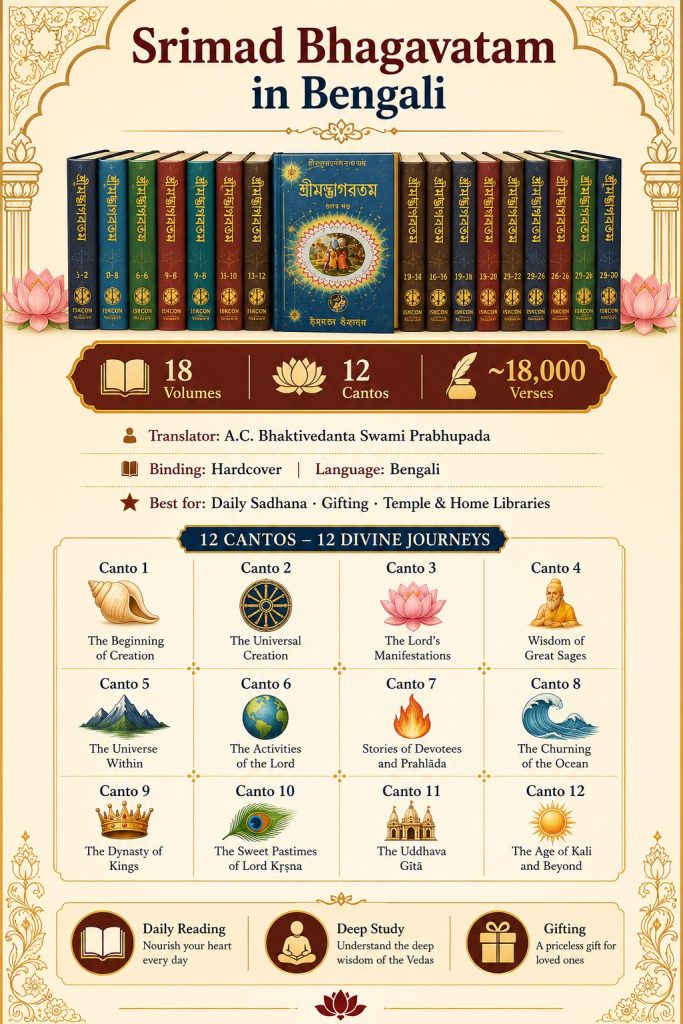
Picture this: a text so vast that reading it cover to cover, at a steady pace, would take most people over a year. Now imagine that text carrying within it the biography of God, the philosophy of the soul, the history of kings who ruled thousands of years ago, and poetry so refined that scholars still argue over its finest verses. That is Srimad Bhagavatam. And when it was translated into Bengali with full Sanskrit verses, word-for-word meanings, and detailed purports, it naturally grew into eighteen substantial volumes. This isn’t padding or publishing gimmickry—it’s simply what happens when you refuse to cut corners on a text this dense. If you’ve ever picked up a single volume from the www.mayapur.store and felt its weight in your hands, you already understand why this set demands eighteen books rather than one.
Most people searching for this set already know the basics—that it’s a sacred text, that it’s connected to Krishna consciousness, that Srila Prabhupada translated it. What they don’t always know is how the eighteen volumes are structured, why the Bengali edition matters so much for readers in West Bengal and Bangladesh, and what actually happens inside each of the twelve cantos that make up this monumental work. That’s what this article is going to unpack.
A Quick Reality Check: Cantos vs. Volumes
Here’s something that trips people up constantly. The Srimad Bhagavatam isn’t originally divided into eighteen parts—it’s divided into twelve cantos (skandhas), each covering a different phase of cosmic and spiritual history. The eighteen-volume structure is a publishing decision, not a scriptural one. Some cantos are short enough to fit comfortably into a single volume. Others — particularly the tenth canto, which describes Krishna’s own pastimes in Vrindavana — are so rich with narrative detail that publishers split them across two or three volumes just to keep each book a manageable size.
So when someone asks “why eighteen volumes instead of twelve cantos?” the honest answer is convenience for the reader, not a change in content. Nothing is added. Nothing is removed. The verses stay exactly where Vyasadeva placed them five thousand years ago.
Where the Story Actually Begins
The First Canto opens not with Krishna, but with a conversation. Sages have gathered in the forest of Naimisharanya for a sacrifice that will last a thousand years, and they ask a simple but loaded question: what is the highest good for humanity? The answer they get sets the tone for everything that follows across all eighteen volumes.
This opening matters more than most readers realize. It frames the entire Bhagavatam not as mythology dumped on a page but as an answer to a genuine philosophical inquiry. Bengali readers, in particular, tend to connect with this framing quickly — the tradition of adda, of sitting and questioning deeply, runs through Bengali intellectual culture, and the Bhagavatam’s opening scene mirrors that instinct perfectly.
From here, the first two cantos lay groundwork:
- The story of Maharaja Parikshit, cursed to die in seven days, who chooses to spend his final week hearing this very text
- An overview of the ten characteristics every Purana is supposed to cover—creation, sustenance, destruction, and more
- Early philosophical distinctions between matter and spirit that later cantos will build on constantly
The Middle Volumes: Where Cosmology Gets Genuinely Strange
Cantos Three through Five cover territory that even seasoned readers find disorienting on a first pass. This is where Srimad Bhagavatam describes the creation of the universe—not as a single event, but as a repeating cycle involving multiple layers of creation, dissolution, and re-creation.
You’ll encounter:
- Brahma’s genealogy — the cosmic family tree that connects nearly every major character in later cantos back to a common ancestral thread
- Detailed cosmography — descriptions of planetary systems that read almost like ancient astronomy texts, mapping out realms both higher and lower than Earth
- The story of King Bharata—whose attachment to a deer in his final moments becomes one of the most quoted cautionary tales in the entire text, illustrating how even a small, seemingly harmless attachment can redirect an entire soul’s trajectory
Bengali translators have historically taken extra care with this section because the terminology gets technical fast. A weak translation here loses readers permanently — they either give up or start skimming, which defeats the purpose of the whole text. The volumes distributed through the Mayapur store use Srila Prabhupada’s purports specifically because they don’t just translate the Sanskrit; they explain why these cosmological details matter to someone living an ordinary life today.
The Turning Point: Cantos Six Through Nine
If the early cantos are about setting up the universe, this middle stretch is about populating it with recognizable moral drama. Canto Six brings the story of Ajamila, a man who fell into a life of complete moral collapse and was still saved in his final moment simply by calling out his son’s name—which happened to also be a name of God. It’s one of the most debated passages in the entire text, precisely because it raises uncomfortable questions about grace, deservingness, and whether spiritual rescue can really be that unconditional.
Canto Seven gives us Prahlada, a child born into a household actively hostile to devotion, whose story remains one of the most emotionally resonant sections for readers of any age. Cantos Eight and Nine trace the Manu dynasties and set the stage—quite literally—for the arrival of the central figure the entire text has been building toward.
A pattern emerges here that’s worth naming directly: every story in these middle cantos, no matter how strange or ancient it sounds, circles back to one question. What actually protects a person when circumstances turn against them? The answers vary in detail but never in substance.
Canto Ten: The Volumes Everyone Actually Buys For
Let’s be honest about something. A large percentage of people who purchase this eighteen-volume set are doing it primarily for Canto Ten. This is where Krishna is born in Mathura, smuggled across a flooded river to Vrindavana, and raised among cowherds who have no idea they’re hosting the Supreme Personality of Godhead in the form of a mischievous, butter-stealing toddler.
Because of its length and popularity, Canto Ten typically spans three separate volumes in the eighteen-volume Bengali set:
- The childhood pastimes—Krishna’s early years, the killing of demons sent by Kamsa, and the beginning of his reputation as a protector
- Vrindavana’s golden years — the rasa dance, the deepening relationship between Krishna and the gopis, and some of the most poetically dense writing in all of Vedic literature
- The journey to Mathura and Dwarka — Krishna’s departure from Vrindavana, the killing of Kamsa, and his transformation from village boy to king and diplomat
For Bengali readers specifically, this canto carries extra emotional weight because of the region’s deep historical connection to Gaudiya Vaishnavism. Sri Chaitanya Mahaprabhu, born in Nabadwip in the fifteenth century, built an entire spiritual movement around exactly these pastimes—the longing of the gopis, the sweetness of Krishna’s Vrindavana life, and the idea that love for God can be as intimate as any human relationship. Reading Canto Ten in Bengali isn’t just reading scripture; for many, it’s reading the emotional source code of their own regional spiritual tradition.
The Final Volumes: Practical Wisdom Wrapped in Farewell
Cantos Eleven and Twelve often get less attention than they deserve, which is a genuine loss for readers who skip them. Canto Eleven contains the Uddhava Gita — Krishna’s final extended teaching, delivered to his closest friend Uddhava just before his departure from this world. It’s dense, philosophical, and in many ways more direct than even the Bhagavad Gita in addressing how a person should actually live once they’ve accepted spiritual truths intellectually.
Canto Twelve closes the entire work with predictions about the future ages, a description of the eventual decline of dharma, and — perhaps most usefully for modern readers — a summary of how the text itself should be approached and preserved. It’s the Bhagavatam looking back at itself and telling future readers how to hold it.
Why the Bengali Translation Specifically Matters
Sanskrit-to-English translations of the Bhagavatam exist in abundance. So why does a Bengali edition deserve its own conversation?
Three reasons stand out:
- Regional resonance — Bengal isn’t a neutral geography for this text. It’s the birthplace of Chaitanya Mahaprabhu, the spiritual epicenter of Gaudiya Vaishnavism, and home to Mayapur itself, considered by practitioners to be the site of Chaitanya’s appearance. Reading the Bhagavatam in Bengali connects readers to a living regional tradition rather than an imported one.
- Linguistic nuance — Bengali carries emotional registers that don’t map cleanly onto English. Words describing devotional longing, the specific flavor of separation (viraha), and the layered meanings in Krishna’s pastimes often land with more precision in Bengali than in translation-of-a-translation English versions.
- Accessibility for a specific audience — Not every reader in West Bengal, Bangladesh, or Bengali-speaking diaspora communities reads English comfortably enough to absorb an 18-volume philosophical text. A native-language edition removes that barrier entirely.
What You’re Actually Getting in Each Volume
People sometimes assume these volumes are just story compilations. They’re not. Each verse in the set typically includes four layers:
- The original Sanskrit verse in Devanagari
- A Bengali transliteration
- Word-for-word Bengali meaning (anvaya)
- A full purpose explaining philosophical, historical, and practical context
This structure is why the set runs to eighteen volumes rather than a slimmer two or three. It’s built for study, not just reading. Someone working through this set methodically — a chapter a day, say — isn’t just absorbing stories. They’re building a working vocabulary in Sanskrit terminology, a framework for Vedic cosmology, and a practical philosophy for daily life, all at once.
A Few Honest Questions Readers Ask Before Buying
Do I need to read all eighteen volumes in order? Not strictly, though it helps. The philosophical concepts build cumulatively—ideas introduced in Canto Two get referenced casually in Canto Nine as if you already know them. Reading out of order works fine for someone who already has background knowledge, but first-time readers generally get more out of a sequential approach.
Is the Bengali edition suitable for someone raised bilingual and more comfortable in English? Often yes, precisely because reading familiar stories in a mother tongue tends to deepen comprehension rather than complicate it, even for readers who are technically stronger in English.
How does this differ from shorter Bhagavatam summaries sold elsewhere? Summaries compress or omit entire sections, particularly the denser cosmological portions in the middle cantos. The full eighteen-volume set leaves nothing out, which matters if the goal is genuine study rather than a surface-level acquaintance with the stories.
The Real Reason This Text Has Survived Five Thousand Years
Strip away the cosmology, the genealogies, and the planetary descriptions for a moment, and you’re left with something almost stubbornly simple: a text insisting that consciousness matters more than circumstance, that devotion outperforms mere ritual, and that even a deeply flawed person can turn things around in a single sincere moment. Ajamila’s story proves it. Prahlada’s story proves it from the opposite direction. Bharata’s story warns of what happens when attention drifts, even slightly, from what actually matters.
Eighteen volumes is a lot to commit to. But the alternative — trying to absorb Krishna consciousness through fragments, quotes, and summaries — tends to leave people with opinions about the Bhagavatam rather than an actual relationship with it. The full set, especially in a language as emotionally rich as Bengali, gives readers something closer to the real thing: a slow, unhurried immersion into a text that was never designed to be rushed in the first place.
For readers in Bengal or anywhere the language carries weight, working through this complete eighteen-volume set isn’t just a reading project. It’s closer to an apprenticeship—one canto, one purport, one quiet realization at a time.


