

What If Consciousness Is More Than Brain Activity?
A human body can be healthy, warm, and physically complete, yet the moment consciousness leaves, everything changes. The same eyes remain, the same heart remains, and the same brain remains. Yet the person is gone.
This simple observation raises one of the deepest questions humanity has ever faced: What is consciousness?
Modern neuroscience has spent decades studying the brain, mapping neural networks, and examining electrical signals. These discoveries have expanded our understanding of cognition, memory, and behavior. Yet the fundamental mystery remains unsolved. How does subjective experience arise? Why does a collection of atoms suddenly become aware of itself?
Thousands of years before consciousness became a topic of scientific debate, the ISKCON Bhagavatam presented a detailed explanation of awareness, identity, perception, and the nature of existence. The Srimad Bhagavatam does not treat consciousness as a byproduct of matter. Instead, it describes consciousness as the defining symptom of the eternal self.
From a Vedic perspective, understanding consciousness is not merely an intellectual exercise. It is the key to understanding life itself.
Why the Srimad Bhagavatam Speaks Directly to Modern Questions
The Srimad Bhagavatam, often called the Bhagavata Purana, occupies a unique place in Vedic literature. It is not simply a historical text, religious scripture, or philosophical commentary. It is a systematic exploration of reality, consciousness, and the relationship between the individual soul and the Supreme.
Unlike many ancient texts that focus primarily on rituals or social systems, the Srimad Bhagavatam repeatedly asks profound questions:
- Who am I?
- Why am I conscious?
- What survives death?
- What is the source of awareness?
- Can consciousness exist independently of the body?
These questions remain at the center of contemporary debates involving neuroscience, psychology, philosophy, and artificial intelligence.
The remarkable aspect of the Bhagavatam is that it begins where many modern discussions end. It assumes consciousness is fundamental and then builds an entire framework around that principle.
The Vedic Definition of Consciousness
According to the Bhagavatam, consciousness is not produced by matter.
Instead, consciousness originates from the atma, the eternal self.
Imagine sunlight entering a room through a window. The light illuminates everything inside the room, making objects visible. In a similar way, the soul illuminates the body through consciousness.
The body itself is compared to a machine.
The soul is the conscious observer.
This distinction is essential because it changes how we view human existence.
From the Vedic standpoint:
The body is possessed by consciousness; it does not create consciousness.
This idea appears repeatedly throughout Vedic literature. Consciousness is described as the symptom of the soul’s presence, just as heat indicates the presence of fire.
When consciousness departs, biological functions cease to have meaning because the conscious observer is no longer present.
The Difference Between the Brain and Consciousness
One of the most fascinating aspects of the Bhagavatam’s teachings is its distinction between the brain and awareness.
Modern science often studies consciousness through the brain because brain activity can be measured.
The Bhagavatam approaches the issue differently.
It acknowledges that the brain is important, but it views the brain as an instrument rather than the source.
Consider a musician playing a flute.
The music emerges through the flute, but the flute itself is not the musician.
Similarly:
- The brain processes information.
- The mind organizes experience.
- Intelligence evaluates choices.
- The soul experiences consciousness.
This layered understanding creates a framework that explains why consciousness feels fundamentally different from physical matter.
Thoughts may be associated with neural activity, yet the observer of those thoughts remains a separate reality.
This observer is called the self.
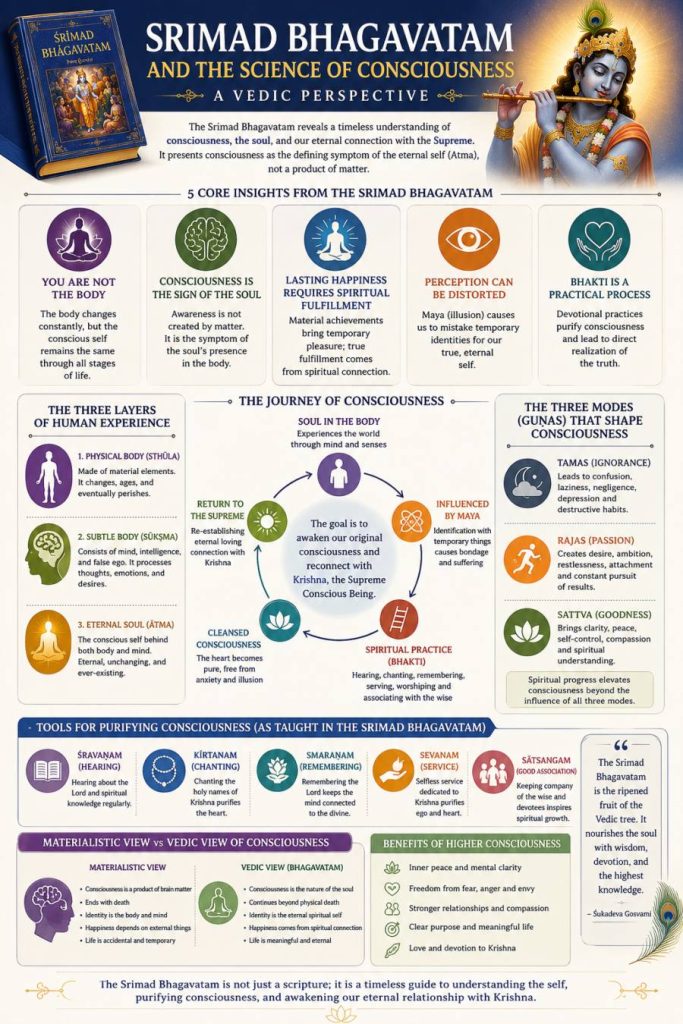
The Three Layers of Human Experience
The Bhagavatam describes human existence as operating through multiple levels.
The Physical Body
This is the visible layer.
It consists of material elements and undergoes constant change.
Cells die and regenerate.
The body ages.
Physical characteristics evolve over time.
Yet despite these changes, a sense of personal identity remains.
The Subtle Body
The Vedic tradition identifies a second layer consisting of:
- Mind
- Intelligence
- False ego
These components cannot be seen directly, but they influence perception, memory, emotions, desires, and decision-making.
The mind receives impressions.
Intelligence analyzes them.
False ego creates identification with temporary labels and roles.
The Eternal Soul
Beyond both physical and subtle layers exists the conscious self.
According to the Bhagavatam, this soul never ages, never dies, and never loses its essential identity.
This eternal self is the true experiencer behind all bodily and mental activities.
Understanding these three levels provides a much broader picture of consciousness than a purely material explanation.
Why Self-Awareness Cannot Be Reduced to Chemistry Alone
Materialistic theories often suggest consciousness emerges when matter becomes sufficiently complex.
The Bhagavatam challenges this assumption.
Its reasoning is surprisingly logical.
Matter can be rearranged endlessly.
Atoms can combine into increasingly sophisticated structures.
Yet no arrangement of unconscious components automatically explains subjective awareness.
A computer may process information.
A camera may recognize faces.
An algorithm may generate language.
But none of these activities necessarily prove inner experience.
The Bhagavatam therefore distinguishes between:
- Information processing
- Genuine consciousness
This distinction has become increasingly relevant in discussions surrounding artificial intelligence.
The Vedic perspective argues that processing data is not the same as possessing awareness.
Awareness belongs to the conscious self.
The Search for the Observer
A fascinating exercise recommended by many Vedic teachers is observing the observer.
Think about your own experience.
You can observe your body.
You can observe your emotions.
You can observe your thoughts.
You can even observe your beliefs.
But who is doing the observing?
The Bhagavatam directs attention toward this witnessing presence.
Everything that can be observed becomes an object of awareness.
The observer itself remains distinct.
This witnessing consciousness is described as the soul.
The more deeply one examines experience, the more difficult it becomes to identify the self solely with physical matter.
The observer appears to stand beyond the changing contents of awareness.
This insight forms the foundation of Vedic psychology.
Consciousness and the Question of Death
Few subjects reveal the limits of material explanations more clearly than death.
From a biological perspective, death represents the cessation of bodily functions.
The Bhagavatam accepts this observation but argues that it is incomplete.
The body stops functioning because the conscious self has departed.
Just as a driver leaving a vehicle renders it inactive, the soul’s departure ends bodily activity.
This understanding transforms the way life and death are viewed.
Death is not considered annihilation.
It is a transition.
The conscious self continues its journey beyond the temporary body.
Because consciousness belongs to the soul rather than the body, awareness itself is not destroyed when the physical form ceases to function.
This principle lies at the heart of Vedic teachings about reincarnation and spiritual evolution.
Is Reality Exactly What We Think It Is?
One of the most thought-provoking teachings found in the Srimad Bhagavatam is the idea that human beings rarely perceive reality as it truly is.
At first glance, that may sound surprising. After all, we trust our eyes, ears, and senses every day. Yet those same senses are limited. We cannot see ultraviolet light. We cannot hear every frequency. We can be fooled by optical illusions, dreams, emotions, and assumptions.
The Bhagavatam argues that perception is filtered through the mind, and the mind itself is influenced by conditioning, desires, fears, memories, and attachments.
This means that what we call “reality” is often a mixture of objective truth and subjective interpretation.
Modern psychology reaches a similar observation. Human beings do not simply experience the world; they interpret it.
The Vedic sages explored this principle thousands of years ago and called the distorting influence maya.
Maya: The Invisible Filter Over Consciousness
The word maya is often translated as “illusion,” but that translation can be misleading.
Maya does not mean that the world is unreal.
Instead, it means that our understanding of reality is incomplete.
Imagine looking through colored glasses.
The world remains the same, but your perception changes.
Similarly, maya affects consciousness by encouraging identification with temporary aspects of existence.
People begin to think:
- I am this body.
- I am my social status.
- I am my achievements.
- I am my possessions.
- I am my temporary emotions.
The Bhagavatam teaches that these identities are not false in a practical sense, but they are incomplete.
A person may be a parent, teacher, business owner, artist, or scholar, yet beneath all those roles exists the eternal conscious self.
The problem begins when temporary labels replace deeper identity.
This misunderstanding becomes the root of anxiety, fear, envy, and dissatisfaction.
Why Material Success Often Fails to Produce Lasting Satisfaction
Many people spend decades pursuing goals they believe will bring happiness.
A better house.
More money.
Recognition.
Power.
Comfort.
Yet history is filled with successful individuals who still felt empty despite achieving extraordinary accomplishments.
The Bhagavatam offers a fascinating explanation.
The soul seeks lasting fulfillment because it is eternal by nature.
Temporary achievements can provide pleasure, but they cannot completely satisfy an eternal being.
This does not mean material success is wrong.
The Bhagavatam never promotes laziness or neglect of responsibilities.
Instead, it teaches balance.
External achievements have value, but they cannot replace inner realization.
A thirsty person cannot satisfy thirst by polishing the outside of a cup.
The water inside matters.
Similarly, consciousness requires nourishment beyond material acquisition.
Bhakti: A Practical Science Rather Than Blind Belief
One reason the Srimad Bhagavatam continues to attract serious thinkers is its practical approach.
The text does not ask readers to accept everything blindly.
Instead, it recommends a process of experimentation.
In modern science, a theory gains credibility when it produces repeatable results.
The Bhagavatam applies a similar principle to spiritual life.
It proposes practices designed to transform consciousness:
- Meditation
- Hearing spiritual wisdom
- Chanting sacred names
- Self-discipline
- Service to others
- Association with spiritually minded people
The claim is straightforward:
If these practices are followed sincerely, consciousness changes.
Clarity increases.
Inner peace grows.
Attachment to destructive habits weakens.
Compassion becomes more natural.
The practitioner becomes the observer of the experiment.
In that sense, bhakti can be understood as a practical science of consciousness.
The Laboratory Is the Human Heart
Traditional science relies on external instruments.
Microscopes reveal cells.
Telescopes reveal galaxies.
Particle accelerators reveal subatomic structures.
The Bhagavatam introduces a different kind of investigation.
Its laboratory is human consciousness itself.
Its instruments include:
- Attention
- Reflection
- Self-awareness
- Meditation
- Spiritual discipline
This approach recognizes that some dimensions of reality can only be understood through direct experience.
No amount of reading about sweetness can replace tasting honey.
Likewise, spiritual realization requires experience rather than theory alone.
The Bhagavatam repeatedly emphasizes realization over mere information.
Knowledge becomes meaningful when it transforms character and perception.
The Three Modes That Shape Human Awareness
A unique contribution of Vedic thought is its description of three fundamental influences affecting consciousness.
These are known as the three gunas or modes of material nature.
Mode of Ignorance (Tamas)
This mode promotes:
- Confusion
- Laziness
- Depression
- Neglect
- Destructive habits
When consciousness becomes dominated by tamas, clarity decreases.
Decision-making becomes clouded.
Motivation weakens.
Mode of Passion (Rajas)
This mode drives activity, ambition, competition, and constant desire.
While passion can create achievement and progress, excessive passion often produces restlessness and dissatisfaction.
The mind becomes trapped in endless pursuit.
Mode of Goodness (Sattva)
Goodness promotes:
- Wisdom
- Peacefulness
- Self-control
- Compassion
- Clear thinking
The Bhagavatam teaches that spiritual understanding becomes easier when consciousness is elevated toward goodness.
Yet it also states that true spiritual realization ultimately rises beyond all three modes.
Read Also:- Mayapur Dham
Consciousness Beyond Matter
Perhaps the most radical claim made by the Bhagavatam is that consciousness can exist independently of material conditions.
This idea stands at the center of Vedic philosophy.
According to the text, the soul does not emerge from matter.
Matter functions because the soul is present.
This distinction changes the entire conversation about identity.
If consciousness survives bodily death, then human life cannot be reduced to biological processes alone.
Purpose becomes larger.
Ethics gain deeper meaning.
Personal growth extends beyond a single lifetime.
The Bhagavatam therefore presents life as part of an ongoing journey rather than a brief accident of chemistry.
The Relationship Between Consciousness and Krishna
The Bhagavatam does not stop at describing individual consciousness.
It also explores the source of all consciousness.
According to its teachings, individual souls are eternally connected with the Supreme Conscious Being, Krishna.
An often-used analogy compares this relationship to the sun and sunlight.
A ray of sunlight possesses qualities similar to the sun:
- Light
- Warmth
- Energy
Yet the ray is not equal to the sun itself.
Similarly, individual consciousness reflects qualities of the Supreme Consciousness while remaining distinct.
This relationship explains why human beings naturally seek:
- Love
- Meaning
- Beauty
- Truth
- Connection
The Bhagavatam teaches that these desires ultimately originate from the soul’s connection with Krishna.
When that connection is forgotten, dissatisfaction emerges.
When it is revived, fulfillment naturally follows.
Why Chanting Affects Consciousness
One of the most discussed practices in the Bhagavatam tradition is mantra meditation.
At first glance, chanting may appear simple.
Yet its purpose reaches far beyond repetition.
The Bhagavatam explains that sound influences consciousness.
Everyday experience confirms this.
Words can inspire.
Words can hurt.
Music can uplift or depress.
Sacred sound is believed to affect consciousness at its deepest level.
The chanting of Krishna’s names is described as a process of cleansing mental distractions and reconnecting awareness with its spiritual source.
Practitioners often report:
- Greater mental clarity
- Reduced anxiety
- Improved focus
- Increased emotional stability
- Stronger sense of purpose
While experiences vary from person to person, the underlying principle remains the same: consciousness changes according to what it consistently absorbs.
A Different Definition of Intelligence
Modern culture often measures intelligence through memory, analytical ability, or academic achievement.
The Bhagavatam introduces a broader definition.
True intelligence means understanding what is temporary and what is eternal.
A person may possess extraordinary technical knowledge yet remain confused about life’s purpose.
Conversely, someone with modest education may possess profound wisdom if they understand the nature of the self.
This perspective shifts the focus from information accumulation to self-realization.
The highest use of intelligence becomes discovering one’s true identity and acting accordingly.
Where Ancient Wisdom Meets Modern Curiosity
The most fascinating aspect of the Srimad Bhagavatam is its continued relevance.
It does not ask readers to reject science.
Nor does it ask them to abandon reason.
Instead, it encourages a deeper investigation of reality.
Science excels at studying external mechanisms.
The Bhagavatam specializes in exploring the conscious observer.
Together, these perspectives address different dimensions of existence.
One examines the machinery.
The other investigates the experiencer.
As conversations about artificial intelligence, neuroscience, psychology, and human awareness continue to evolve, the Bhagavatam offers a remarkably sophisticated framework that remains as intriguing today as it was thousands of years ago.
Its central message is both simple and profound:
You are more than your body.
You are more than your thoughts.
You are a conscious, eternal being whose deepest fulfillment comes from reconnecting with the source of all consciousness.
That understanding transforms spirituality from belief into realization and turns the study of consciousness into a personal journey rather than a purely academic pursuit.
What the Srimad Bhagavatam Ultimately Teaches About Consciousness
After exploring the Bhagavatam’s perspective on the soul, perception, identity, and spiritual practice, one truth stands above everything else: consciousness is not an accident.
The Vedic sages did not view awareness as a random byproduct of matter. They saw consciousness as the defining characteristic of life itself. Every experience, relationship, aspiration, and question begins with the conscious self.
This insight carries enormous implications.
If consciousness is fundamental, then understanding consciousness becomes one of the most important pursuits of human life. Wealth, achievements, social recognition, and technological progress may improve external conditions, but they do not automatically answer the deeper questions that arise within every thoughtful person.
Questions such as:
- Why do I exist?
- What remains unchanged despite the body’s constant transformation?
- Why do material achievements often fail to provide lasting fulfillment?
- Is there a reality beyond physical perception?
The Srimad Bhagavatam approaches these questions with remarkable confidence. It proposes that beneath changing circumstances exists an eternal conscious being—the soul—and that the soul’s natural state is loving connection with the Supreme.
From this perspective, spiritual life is not an escape from reality. It is an attempt to see reality more clearly.
The Bhagavatam repeatedly emphasizes that self-realization is not reserved for monks, scholars, or mystics living in isolation. It is available to anyone willing to engage sincerely with spiritual knowledge and practice.
That practical nature is one reason the text has inspired generations of seekers across different cultures and historical periods.
The Relevance of the Bhagavatam in the Age of Artificial Intelligence
Humanity is entering an era where machines can imitate conversation, create art, analyze data, and perform tasks once believed to require intelligence.
As technology advances, an important distinction becomes increasingly relevant:
Is intelligence the same as consciousness?
The Bhagavatam answers with a clear no.
Information processing and conscious experience are not identical.
A machine may generate responses.
A computer may evaluate probabilities.
An algorithm may learn patterns.
Yet the Bhagavatam maintains that awareness itself belongs to the conscious self.
This distinction is becoming one of the most significant philosophical questions of the modern age.
As society continues exploring artificial intelligence, neuroscience, and cognitive science, the Bhagavatam offers a framework that addresses the observer behind the information.
Rather than asking only how thinking occurs, it asks who is experiencing the thinking.
That question remains as powerful today as it was thousands of years ago.
Why the Science of Consciousness Is Also a Science of Living
Many people assume spiritual knowledge concerns only what happens after death.
The Bhagavatam presents a very different picture.
Understanding consciousness directly influences everyday life.
When people identify solely with temporary circumstances, they often become overwhelmed by:
- Fear of loss
- Anxiety about the future
- Excessive attachment
- Competition and envy
- Dissatisfaction despite success
The Bhagavatam teaches that recognizing one’s spiritual identity changes the way these challenges are experienced.
This does not eliminate difficulties.
Life continues to contain uncertainty, responsibility, and hardship.
What changes is perspective.
A person who understands the eternal nature of the self develops a deeper sense of stability amidst external change.
This stability becomes the foundation for genuine peace.
Five Timeless Lessons from the Srimad Bhagavatam
1. You Are Not the Body
The body is important and should be cared for, but it is not the entirety of who you are.
The soul remains the constant observer through every stage of life.
2. Consciousness Is the Sign of the Soul
Awareness is not treated as a product of matter but as evidence of the presence of the conscious self.
3. Lasting Happiness Requires Spiritual Fulfillment
Material achievements provide temporary satisfaction, but deeper fulfillment arises from reconnecting with one’s spiritual nature.
4. Perception Can Be Distorted
The influence of maya causes people to mistake temporary identities for their true selves.
Spiritual wisdom helps remove this distortion.
5. Bhakti Is a Practical Process
The Bhagavatam presents devotion not as blind faith but as a transformative discipline capable of changing consciousness through direct experience.
The End Goal: Awakening the Original Consciousness
According to the Bhagavatam, the purpose of spiritual practice is not merely becoming more peaceful, ethical, or knowledgeable.
Those benefits naturally occur, but they are not the final destination.
The ultimate goal is awakening pure consciousness.
Pure consciousness means seeing oneself, others, and the Supreme Reality without the distortions created by selfish desires and temporary identifications.
In that awakened state:
- Love becomes unconditional.
- Compassion becomes natural.
- Fear diminishes.
- Inner fulfillment increases.
- Life gains a clear sense of meaning.
The Bhagavatam describes this state as the soul’s original condition.
It is not something artificial that must be created.
It is something already present that must be uncovered.
Final Thoughts
The search for consciousness may be the most important investigation humanity ever undertakes.
Scientists explore the brain.
Philosophers analyze awareness.
Psychologists study behavior.
The Srimad Bhagavatam contributes another dimension to this search by examining the eternal observer behind every experience.
Its teachings challenge the assumption that life can be fully explained through matter alone. They encourage readers to look inward, question deeply, and explore the possibility that consciousness is more fundamental than physical reality itself.
Whether approached as philosophy, spirituality, psychology, or a guide to self-realization, the Srimad Bhagavatam continues to offer insights that remain remarkably relevant in the modern world.
Its message is timeless:
The conscious self is eternal, consciousness is sacred, and life’s deepest fulfillment comes from reconnecting with the Supreme Source of all consciousness.
Frequently Asked Questions (FAQs)
What is the Srimad Bhagavatam?
The Srimad Bhagavatam, also known as the Bhagavata Purana, is one of the most important texts of the Vedic tradition. It explores spirituality, devotion, consciousness, cosmology, ethics, and the relationship between the individual soul and Krishna.
How does the Srimad Bhagavatam define consciousness?
The Bhagavatam teaches that consciousness is the symptom of the soul’s presence. Rather than being created by matter, consciousness originates from the eternal self (atma).
Is the Bhagavatam compatible with modern scientific inquiry?
While the Bhagavatam and modern science use different methods, both seek to understand reality. Science focuses primarily on external mechanisms, whereas the Bhagavatam investigates the conscious observer and the nature of awareness itself.
What is the role of bhakti in understanding consciousness?
Bhakti, or devotional service, is presented as a practical process for purifying consciousness. Through practices such as hearing spiritual wisdom, chanting, and service, individuals can experience higher levels of awareness and self-realization.
Why is the Srimad Bhagavatam relevant today?
Questions about consciousness, identity, happiness, purpose, and reality remain central to modern life. The Bhagavatam offers a sophisticated framework for understanding these issues from a spiritual perspective.


