

From Majuli to Mayapur: Carrying the Legacy of Devotion through the Gita
Across the vast spiritual landscape of India, there are certain places where devotion does not feel taught—it feels lived. These places do not merely preserve tradition; they breathe it into every moment of daily life. Two such sacred centers, though geographically distant, are deeply connected through a shared current of bhakti: Majuli and Mayapur.
For seekers who wish to carry this legacy forward in their own lives, resources like the ISKCON Mayapur Store offer more than books—they offer continuity, connecting ancient wisdom with modern hearts.
From the serene satras of Majuli, where devotion flows through art, music, and simplicity, to the vibrant spiritual hub of Mayapur, where the teachings of the Bhagavad Gita reach a global audience, the journey between these two places is not just physical—it is deeply internal.
It is a journey of understanding devotion not as a ritual but as a living philosophy.
Majuli: The Island Where Devotion Breathes
Majuli, the world’s largest river island, rests quietly on the Brahmaputra in Assam. But its significance is far greater than its geography. It is a spiritual ecosystem shaped by the teachings of Srimanta Sankardev, who emphasized devotion through simplicity, community, and art.
Here, bhakti is not confined to temples. It is expressed in dance, music, storytelling, and daily living. The satras (monastic institutions) serve as centers of both spiritual practice and cultural preservation.
What makes Majuli unique is its softness. Devotion here is gentle, unforced, and deeply integrated into life. There is no rush, no pressure—only a steady rhythm of remembrance.
Psychologically, this creates a state of inner calm. When spirituality is woven into daily routines, it stops feeling like an obligation and becomes a natural extension of being.
The Gita: A Bridge Between Worlds
While Majuli embodies devotion in practice, the Bhagavad Gita provides its philosophical foundation.
The Gita does not belong to a single region or tradition. It is universal. Its teachings transcend geography, language, and time. It speaks directly to the human condition—confusion, doubt, fear, and the search for purpose.
At its core, the Gita teaches one essential truth: act with devotion, but without attachment.
This principle becomes the bridge between Majuli and Mayapur.
In Majuli, devotion is expressed through cultural life.
In Mayapur, it is systematized and shared globally.
And the Gita connects both—offering clarity to devotion.
Mayapur: The Global Heart of Bhakti
Located in West Bengal, Mayapur stands as one of the most important centers of Gaudiya Vaishnavism. It is known worldwide as the birthplace of Sri Chaitanya Mahaprabhu, who propagated the congregational chanting of the holy names.
Unlike the quiet stillness of Majuli, Mayapur is vibrant and expansive. Devotees from across the globe gather here, creating a unique blend of cultures united by a single purpose—devotion.
What makes Mayapur powerful is its ability to translate ancient wisdom into a global language. Through teachings, kirtan, literature, and community living, it carries the message of the Gita beyond traditional boundaries.
This is where devotion becomes accessible.
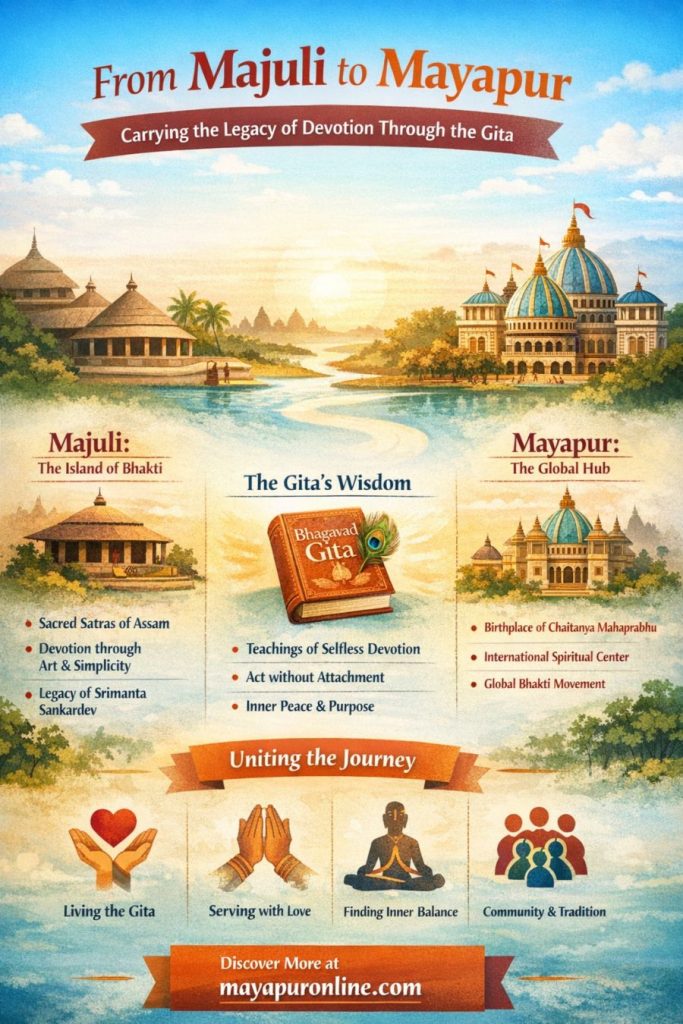
Two Paths, One Essence
At first glance, Majuli and Mayapur may seem different.
Majuli is rooted in regional culture.
Mayapur is globally connected.
Majuli expresses devotion through tradition.
Mayapur expresses it through expansion.
Yet, beneath these differences lies the same essence—bhakti.
Both teach that devotion is not about external identity. It is about internal alignment.
Whether through the quiet discipline of satras or the dynamic energy of kirtan festivals, the goal remains the same: to connect with the divine through sincere devotion.
The Psychological Power of Devotion
One of the most overlooked aspects of bhakti is its psychological impact.
In a world filled with stress, comparison, and constant stimulation, the mind becomes restless. People seek peace externally but rarely find it.
Devotion offers a different approach.
Instead of trying to control external circumstances, it focuses on transforming internal experience.
The Gita explains this clearly. When actions are performed with devotion and without attachment, the mind becomes stable.
This stability is not passive. It is deeply active—allowing individuals to engage with life fully but without being overwhelmed by it.
Majuli demonstrates this through simplicity.
Mayapur demonstrates this through community.
Both lead to the same outcome: inner balance.
Carrying the Legacy: From Place to Practice
The journey from Majuli to Mayapur is not just about visiting sacred places. It is about carrying their essence into everyday life.
This is where the teachings of the Gita become practical.
You do not need to live on an island or in a temple to practice devotion. You can carry it into your work, your relationships, and your decisions.
- Acting with sincerity
- Letting go of unnecessary expectations
- Finding meaning in service
- Staying grounded in awareness
These are not abstract ideas. They are daily practices.
And when practiced consistently, they transform not just behavior but perception.
Devotion in the Modern World
Modern life is fast, fragmented, and often overwhelming. Attention is divided, priorities shift quickly, and meaning can feel elusive.
In such an environment, devotion might seem outdated.
But in reality, it is more relevant than ever.
Because devotion is not about escaping the world. It is about engaging with it more consciously.
The Gita does not ask you to withdraw. It asks you to act with clarity.
This is what makes its teachings timeless.
The Role of Community and Tradition
One of the strengths of both Majuli and Mayapur is their emphasis on community.
Devotion, when practiced alone, can feel difficult to sustain. But when shared, it becomes powerful.
In Majuli, community is rooted in tradition.
In Mayapur, it is built through global connection.
Both provide support, inspiration, and continuity.
This highlights an important truth: spirituality is not just individual—it is collective.
The Living Legacy of the Gita
The Bhagavad Gita is not just a text to be read. It is a guide to be lived.
Its teachings have traveled across centuries, cultures, and continents—not because they were preserved, but because they were practiced.
Majuli preserves its spirit through cultural expression.
Mayapur expands its reach through global engagement.
Together, they ensure that the legacy of devotion continues.
Conclusion: A Journey That Never Ends
The path from Majuli to Mayapur is not measured in kilometers.
It is measured in understanding.
It is the journey from external practice to internal realization. From ritual to meaning. From confusion to clarity.
And at the center of this journey is the Gita—a timeless guide that continues to illuminate the path of devotion.
In a world that often feels disconnected, this legacy offers something rare.
Not just answers—but direction.
Not just belief—but experience.
And most importantly, not just tradition but transformation.


