

Why Does a Simple Clay Hold Such Deep Spiritual Meaning?
Walk into a Vaishnava temple during the early morning hours and you will notice something distinctive. Devotees may come from different countries, speak different languages, and follow different daily routines, yet many share one visible symbol—a sacred tilak made from Gopi Chandan.
At first glance, it appears to be nothing more than a pale yellow clay. Yet for centuries, saints, scholars, and devotees have regarded it as spiritually powerful and deeply significant. It is not merely applied to the forehead as a religious mark. It represents devotion, remembrance of Krishna, spiritual identity, and connection with an ancient tradition that stretches back thousands of years.
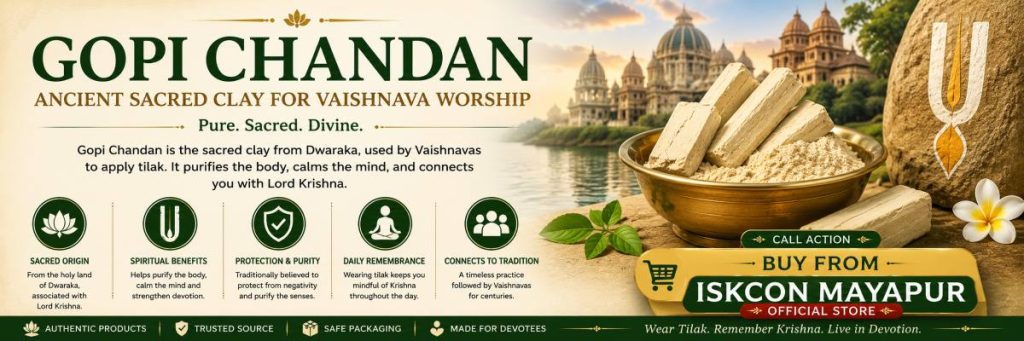
Many devotees purchase authentic Gopi Chandan from the ISKCON Mayapur Official Store to ensure they receive traditional Vaishnava products that align with scriptural standards and devotional practices.
What makes this sacred clay so special? Why has it remained an essential part of Vaishnava worship across generations? The answer lies in history, scripture, symbolism, and the transformative role it plays in daily spiritual life.
What Exactly Is Gopi Chandan?
Gopi Chandan is a sacred yellowish clay traditionally obtained from holy regions associated with Lord Krishna’s divine pastimes, particularly the area of Dwaraka in Gujarat, India.
The term itself consists of two words:
- Gopi – the exalted cowherd maidens of Vrindavan, celebrated for their pure devotion to Krishna.
- Chandan – often associated with sandalwood paste, cooling substances, and sacred application.
Although it is clay rather than sandalwood, the name reflects its sacred connection with Krishna’s devotees and holy places.
For Vaishnavas, Gopi Chandan is not viewed as ordinary earth. It is considered spiritually sanctified due to its association with sacred locations connected to Krishna’s eternal pastimes.
When mixed with a small amount of water, the clay forms a smooth paste used for applying tilak on different parts of the body.
The Fascinating Origin Story Behind Gopi Chandan
Every sacred object carries a story, and Gopi Chandan is no exception.
Ancient Vaishnava traditions describe Dwaraka as one of the most important holy cities in Hindu history. It served as Lord Krishna’s royal kingdom after His departure from Vrindavan.
According to traditional accounts preserved within Vaishnava communities, the sacred clay found in the Dwaraka region became spiritually charged through Krishna’s presence and divine activities.
Some devotional narratives explain that this clay is connected to the intense devotion of Krishna’s eternal associates. Others emphasize its association with sacred lakes and holy sites where divine pastimes unfolded.
Regardless of which traditional explanation one follows, the underlying principle remains the same:
The spiritual significance of Gopi Chandan comes from its connection to Krishna and His devotees.
This connection transforms a natural substance into a sacred medium for remembrance and worship.
More Than a Mark: The Hidden Meaning of Vaishnava Tilak
Many people assume tilak is simply a religious decoration.
Vaishnava philosophy presents a much deeper understanding.
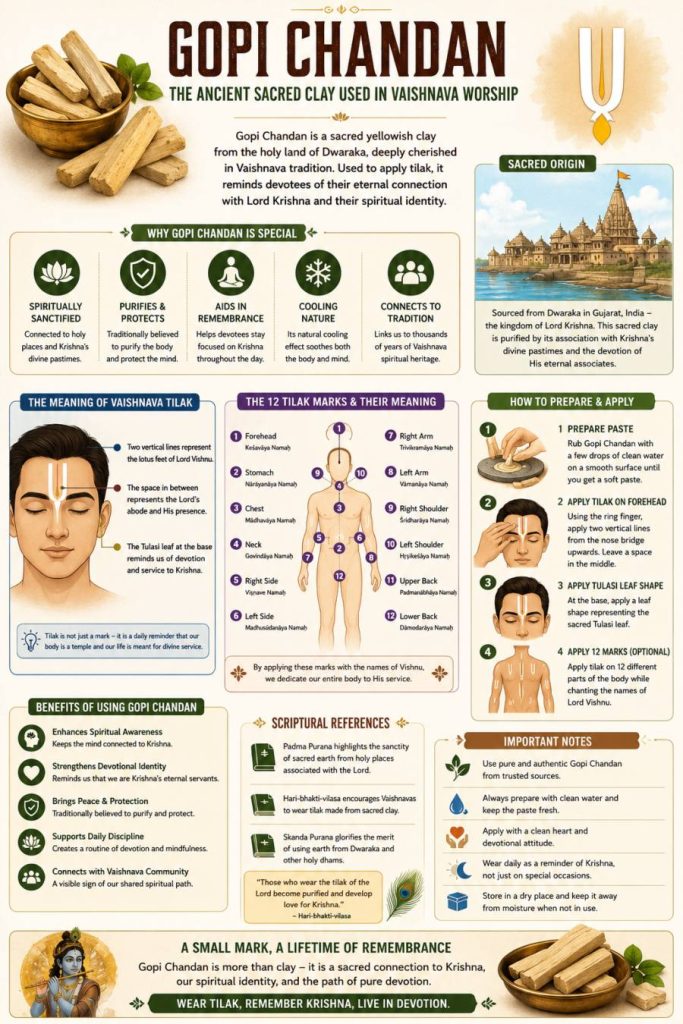
The U-shaped tilak applied using Gopi Chandan symbolizes the lotus feet of Lord Vishnu or Krishna. The central space between the vertical lines is often understood as representing the Lord’s presence or His sacred abode.
Each time a devotee applies tilak, it serves as a reminder:
- The body belongs to God.
- Life has a spiritual purpose.
- Every action should be offered in devotion.
- Material identity is temporary.
- The soul’s eternal relationship with Krishna is permanent.
This transforms a daily ritual into a powerful spiritual meditation.
Rather than merely announcing one’s religious affiliation, tilak functions as a personal reminder of divine service throughout the day.
Why Vaishnavas Apply Gopi Chandan Every Day
Daily application of Gopi Chandan is deeply rooted in Vaishnava practice.
The purpose extends far beyond tradition.
1. Constant Remembrance of Krishna
The human mind easily becomes distracted.
Work, responsibilities, social obligations, and endless streams of information constantly compete for attention.
Tilak serves as a visible reminder of spiritual priorities.
Every glance in a mirror reinforces devotional consciousness.
2. Spiritual Identity
Modern society encourages identification through profession, nationality, wealth, or social status.
Vaishnava teachings encourage a different perspective.
The soul’s identity is eternal and transcends temporary labels.
Applying Gopi Chandan reflects this understanding.
3. Respect for the Body as a Temple
Many Vaishnava scriptures describe the body as a temple of God.
Just as temples are decorated and purified before worship, devotees prepare their bodies through sacred practices.
Tilak becomes part of this process.
4. Participation in an Ancient Tradition
When devotees apply Gopi Chandan today, they participate in a practice followed by saints and spiritual teachers for generations.
This continuity creates a living connection with the spiritual heritage of Vaishnavism.
The Twelve Tilak Marks and Their Spiritual Significance
A unique aspect of Vaishnava practice involves applying tilak to twelve different parts of the body.
Each location is associated with a particular name of Lord Vishnu.
Common locations include:
- Forehead
- Stomach
- Chest
- Neck
- Right side of abdomen
- Left side of abdomen
- Right arm
- Left arm
- Right shoulder
- Left shoulder
- Upper back
- Lower back
While applying each mark, devotees traditionally chant specific names of Vishnu.
This practice transforms what could be a routine action into an act of prayer and meditation.
The body becomes spiritually dedicated through conscious remembrance.
Scriptural References That Praise Gopi Chandan
The importance of sacred clay is mentioned throughout various Vaishnava texts and traditional commentaries.
These references consistently emphasize themes such as:
- Purification
- Devotional identity
- Remembrance of God
- Spiritual protection
- Sacred association
Vaishnava acharyas repeatedly encouraged devotees to wear tilak because it keeps consciousness aligned with devotional principles.
The emphasis is not on external appearance alone.
The external mark should reflect an internal attitude of humility, devotion, and service.
Without genuine devotion, tilak becomes merely cosmetic.
With sincere devotion, it becomes a meaningful expression of spiritual life.
Read More: Mayapur Dham
Why the Cooling Nature of Gopi Chandan Matters
One interesting feature of Gopi Chandan is its naturally cooling quality.
In many regions of India, devotees traditionally appreciate its soothing effect during hot weather.
Yet Vaishnava teachers often draw a symbolic lesson from this physical characteristic.
The material world can create the following:
- Anxiety
- Anger
- Frustration
- Competition
- Mental agitation
Devotional practices help cool these inner disturbances.
In that sense, Gopi Chandan becomes a symbolic reminder that spiritual consciousness brings peace and clarity.
The cooling clay on the forehead serves as a physical reflection of the calmness devotees seek within their hearts.
Not All Sacred Clay Is the Same
Many forms of sacred earth exist throughout Hindu traditions.
Examples include clay from holy rivers, temple grounds, pilgrimage sites, and sacred mountains.
Gopi Chandan occupies a unique place within Vaishnavism because of its direct association with Krishna’s Dwaraka pastimes and longstanding acceptance among Vaishnava lineages.
For this reason, devotees often seek authentic sources to ensure the clay is traditionally prepared and properly sourced.
Quality matters because sacred items are used directly in worship and daily spiritual practices.
How to Apply Gopi Chandan Properly
Applying Gopi Chandan is simple, yet the process carries deep spiritual meaning. The goal is not artistic perfection but sincere remembrance of Krishna.
Step 1: Prepare the Paste
Take a small piece of Gopi Chandan and place a few drops of clean water on a smooth stone, tile, or dedicated tilak board.
Gently rub the clay in circular motions until a smooth paste forms.
The consistency should be neither too thick nor too watery. A creamy texture makes application easier and produces clean tilak lines.
Step 2: Maintain a Devotional Mood
Before applying tilak, many devotees silently remember Krishna, offer a short prayer, or chant the Hare Krishna maha-mantra.
This transforms the activity from a routine task into an act of worship.
Step 3: Apply the Forehead Tilak
Using the ring finger or a tilak applicator, draw two vertical lines beginning near the bridge of the nose and extending upward toward the hairline.
Leave a narrow space in the center.
At the base, a leaf-shaped mark is traditionally drawn, symbolizing the sacred Tulasi leaf offered to Krishna.
Step 4: Apply the Remaining Marks
Advanced practitioners often apply tilak on twelve parts of the body while reciting corresponding names of Lord Vishnu.
This practice sanctifies the body and reinforces devotional awareness throughout the day.
The Spiritual Benefits Devotees Associate with Gopi Chandan
The value of Gopi Chandan cannot be measured through laboratory testing or material analysis. Its significance is spiritual rather than scientific.
Devotees commonly associate several benefits with the practice.
Constant God Consciousness
One of the greatest challenges in spiritual life is maintaining remembrance of God amid daily responsibilities.
Tilak acts as a visual reminder throughout the day.
Each glance in a mirror brings consciousness back toward Krishna.
Increased Sense of Purpose
Many practitioners describe feeling more connected to their spiritual identity when wearing tilak.
It serves as a reminder that life is not solely about earning, consuming, and competing.
There is a higher purpose behind existence.
Sense of Sacred Discipline
Small daily rituals often create powerful long-term habits.
The simple act of applying Gopi Chandan every morning helps establish consistency in spiritual practice.
Connection to a Larger Community
Whether a devotee lives in India, Europe, America, Africa, or Australia, tilak creates a visible bond with millions of Vaishnavas around the world.
It reflects participation in a shared spiritual tradition.
Gopi Chandan and the Heart of Gaudiya Vaishnavism
Within Gaudiya Vaishnavism, Gopi Chandan holds special importance.
The tradition established by Sri Chaitanya Mahaprabhu emphasizes loving devotion to Krishna above all else.
External practices are valued when they support internal devotion.
Tilak serves exactly that purpose.
Gaudiya teachers have long encouraged devotees to wear tilak because it helps cultivate:
- Humility
- Remembrance
- Spiritual discipline
- Service attitude
- Devotional identity
The practice remains common throughout temples, ashrams, pilgrimage sites, and households connected with the Gaudiya tradition.
Why ISKCON Devotees Wear Gopi Chandan Daily
The International Society for Krishna Consciousness continues the teachings of A. C. Bhaktivedanta Swami Prabhupada, who emphasized practical devotional living.
Within ISKCON communities, Gopi Chandan is widely used for daily tilak application.
Devotees often apply tilak:
- Before attending temple programs
- During morning worship
- Prior to deity service
- Before chanting japa
- During festivals and special ceremonies
Prabhupada repeatedly stressed that devotional practices should help devotees remember Krishna at every stage of life.
Tilak serves as one of those reminders.
For many devotees, applying Gopi Chandan marks the beginning of a spiritually focused day.
The Connection Between Gopi Chandan and Tulasi Worship
An often-overlooked aspect of Vaishnava culture is the close relationship between Gopi Chandan and Tulasi Devi.
Tulasi is considered exceptionally dear to Krishna.
Traditional tilak includes a leaf-shaped mark at the base, representing Tulasi.
This symbolism carries an important message.
Vaishnava worship is not centered solely on God.
It also honors God’s devotees.
Just as Krishna is worshiped, His beloved devotees are respected and remembered.
The Tulasi-shaped portion of the tilak reflects this beautiful devotional principle.
Common Misconceptions About Gopi Chandan
“It’s Just Religious Makeup”
This is perhaps the most common misunderstanding.
Makeup enhances appearance.
Tilak serves as a spiritual reminder.
Its purpose is devotional rather than cosmetic.
“Only Monks Wear It”
Many householders wear Gopi Chandan daily.
Business owners, teachers, students, engineers, doctors, and parents all participate in the practice.
“You Need to Be a Scholar”
Not at all.
One does not need advanced scriptural knowledge to apply tilak.
Sincerity matters more than academic expertise.
“It Has Magical Powers”
Traditional teachings do not present Gopi Chandan as a magical object.
Its significance comes from devotion, remembrance, and spiritual association.
The clay itself is sacred because of its connection to Krishna and devotional practice.
The Deeper Symbolism Most People Never Notice
Many devotees learn how to apply tilak but never fully explore its symbolism.
The two vertical lines represent more than a design.
They remind practitioners that the human body should serve as a temple.
The empty space between the lines is equally meaningful.
A temple is valuable because God resides within it.
Similarly, the body gains spiritual significance when dedicated to divine service.
This symbolism shifts one’s perspective.
Rather than seeing the body as an instrument for temporary enjoyment, devotees learn to view it as a sacred gift meant for serving Krishna.
That single change in perspective can transform daily life.
Why Ancient Practices Still Matter in the Modern World
Some people question whether practices like tilak remain relevant in the twenty-first century.
The answer depends on what people are seeking.
Technology has improved communication, transportation, medicine, and convenience.
Yet many individuals still struggle with:
- Stress
- Loneliness
- Anxiety
- Lack of meaning
- Spiritual disconnection
Ancient devotional practices address a different dimension of human life.
They focus on purpose, identity, and inner fulfillment.
Gopi Chandan continues to matter because the fundamental questions of human existence have not changed.
People still ask:
- Who am I?
- Why am I here?
- What brings lasting happiness?
- What happens beyond this life?
Vaishnava traditions use practices like tilak to keep these questions alive rather than allowing them to be buried beneath daily distractions.
Choosing Authentic Gopi Chandan
Because devotional products are increasingly available online, quality can vary significantly.
When selecting Gopi Chandan, devotees often look for:
- Traditional sourcing
- Authentic Vaishnava suppliers
- Proper texture and consistency
- Trusted devotional organizations
- Positive reputation within the devotee community
Authentic products help preserve the integrity of devotional practices and ensure alignment with traditional standards.
Many devotees prefer obtaining sacred items from established Vaishnava institutions and trusted spiritual suppliers that have long served the devotional community.
Frequently Asked Questions About Gopi Chandan
Can anyone wear Gopi Chandan?
Yes. Anyone interested in Vaishnava devotional practices may wear Gopi Chandan respectfully.
Is it necessary to apply all twelve tilak marks?
No. Many devotees begin with the forehead tilak and gradually learn the complete process.
Does Gopi Chandan expire?
Properly stored Gopi Chandan remains usable for many years because it is natural clay.
Can women wear Gopi Chandan?
Yes. Women within many Vaishnava traditions wear tilak, though styles may vary according to local customs and lineage traditions.
Is Gopi Chandan only used by ISKCON devotees?
No. Various Vaishnava traditions have used Gopi Chandan for centuries, long before the establishment of ISKCON.
What makes it different from ordinary clay?
Its spiritual significance comes from its sacred origin, scriptural acceptance, and longstanding role in devotional worship.
Final Thoughts: A Small Mark with Timeless Meaning
At first glance, Gopi Chandan appears remarkably simple. It is merely a natural clay taken from sacred land and mixed with water.
Yet simplicity often hides profound meaning.
For generations of Vaishnava devotees, this sacred clay has represented devotion, remembrance, humility, and spiritual identity. It connects modern practitioners with ancient saints, sacred places, and the eternal teachings of Krishna consciousness.
The value of Gopi Chandan is not found in its appearance but in what it encourages within the heart. Every application becomes a reminder that life has a higher purpose. Every tilak mark serves as an invitation to remember Krishna amid the noise and distractions of daily life.
That is why Gopi Chandan has endured across centuries.
Empires have risen and fallen. Cultures have changed. Technologies have transformed society. Yet devotees continue to apply this sacred clay each day because its message remains timeless: the soul belongs to Krishna, and true fulfillment comes through loving devotional service.
For those seeking a deeper connection with Vaishnava traditions, Gopi Chandan remains one of the most meaningful and accessible spiritual practices available today.


